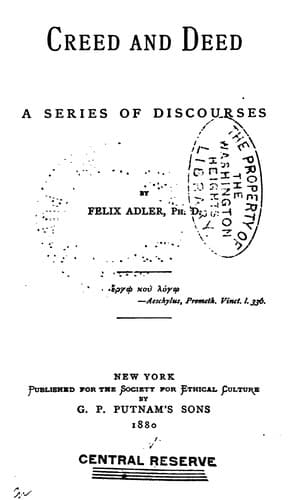
Creed and Deed: A Series of DiscoursesAdler, Felix
Religion
Creed and Deed: A Series of Discourses
Adler, Felix
Ethical culture movement; Ethics; Religion
Religion, however, was Spinoza's favorite theme, that religion which is
free from all passionate longings and averse to superstition of whatever
kind. He was among the first to hurl his mighty arguments against
the infallible authority of the Bible, arguments that still command
attention though two hundred years have since passed by. Miracles, he
said, are past belief, the beauty of Cosmos is far more deserving
of admiration than any so called miracle could possibly be. He
demanded--this was a great and novel claim--that the methods of natural
science be applied to the study of scripture, that the character of the
age and local surroundings be considered in determining the meaning of
each scriptural author. In brief that a natural history of the bible,
so to speak, should be attempted. He claimed that the priesthood had
falsified the very book which they professed to regard most holy.
He denied the Mosaic authorship of the Pentateuch, and set forth in
singularly clear and lucid language the discrepancies in which that work
abounds. He closed the treatise in which these views are laid down--the
Theologico-political Tract--with a magnificent plea for liberty of
conscience and of speech. That state alone, he says, can be free and
happy which rests on the freedom of the Individual citizen. Where the
right of free utterance is curtailed, hypocrisy and shameful conformance
flourish, and public contumely and disgrace which ought to serve as a
mete punishment for the vicious, become a halo about the head of the
most noble of men. Religion and piety, he concludes, the state has a
right to demand, but nothing hereafter shall be known as religion and
piety save the practice of equity and of a wise and helpful love.
It was a bold awakening note which thus rang out into the seventeenth
century, and theologians were bitter in their replies. The book was
confiscated and Christian curses were added to Jewish anathemas. But
they failed to affect Spinoza.
Public-domain text, read in full here on John Shaqi.
Reviews
Reviews
No reviews yet
Be the first to share your thoughts on this work.
Elsewhere in the archive
Join the Discussion
Join the discussion
Sign in to leave a comment or review.
Sign InorCreate an account