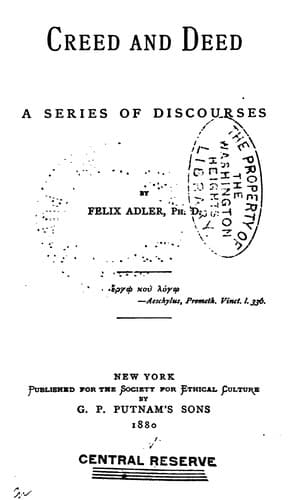
Creed and Deed: A Series of DiscoursesAdler, Felix
Religion
Creed and Deed: A Series of Discourses
Adler, Felix
Ethical culture movement; Ethics; Religion
Few men have suffered as he did. Few have preserved the same equanimity
of soul in the face of adverse fortune. Twenty years he dwelt alone. For
days he did not leave his student's closet, drawing his mighty circles,
intent on those high thoughts that formed the companionship he loved.
Those that knew him well revered him. De Witt the noble statesman, De
Witt who ended his days so miserably, torn to pieces by a maddened mob,
sought his counsel. Young ardent disciples from a distance sent him
words of cheer into his solitude. His soul was pure as sunlight, his
character crystal clear. He was frugal in the extreme: a few pence a day
sufficed to sustain him. Not that he affected austere views in general,
but the deep meditations that occupied his mind left him little time
or inclination for the grosser pleasures. His sense of honor was
scrupulously nice. Again and again did he reject the munificent pensions
which his friends pressed upon him; he would be free and self-sustained
in all things. In his leisure hours he busied himself with the grinding
and polishing of optical lenses, an exercise that offered him at once
the means of support and a welcome relaxation from the severe strain
of mental effort. His temper was rarely ruffled; he was placid, genial,
childlike. When wearied with his labors he would descend to the family
of his landlord, the painter Van der Speke, and entering into the
affairs of these simple people, he found, in their unaffected converse,
the relief he sought.
He valued the peace of mind which he had purchased so dearly. When the
Elector of the Palatinate offered him the chair of philosophy at the
University of Heidelberg on condition that he would so expound his
philosophy as not to interfere with the established religion, he
declined, replying that he could teach the truth only as he saw it, and
that evil and designing men would doubtless add point and poison to his
words. Yet he was fearless. When toward the close of his career,
his life was again imperiled, the grave tranquillity of his demeanor
inspired his agitated friends with calmness and confidence.
He had gained his forty-fourth year. For half a life time he had been
fighting a treacherous disease, that preyed in secret upon his health.
His life was slowly ebbing away amidst constant suffering, yet no
complaint crossed his lips and his nearest companions were hardly
aware of what he endured. In the early part of the year 1677 one day
in February, while the family of the painter were at church the end
approached. Only a single friend was with him. Calmly as he had lived,
in the stillness of the Sunday afternoon, Spinoza passed away.
Public-domain text, read in full here on John Shaqi.
Reviews
Reviews
No reviews yet
Be the first to share your thoughts on this work.
Elsewhere in the archive
Join the Discussion
Join the discussion
Sign in to leave a comment or review.
Sign InorCreate an account