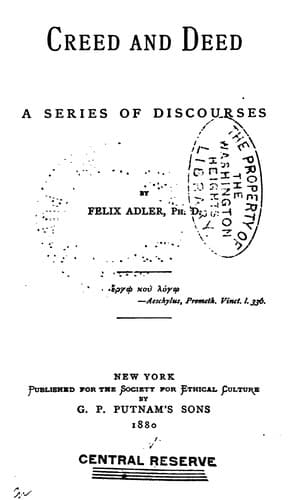
Creed and Deed: A Series of DiscoursesAdler, Felix
Religion
Creed and Deed: A Series of Discourses
Adler, Felix
Ethical culture movement; Ethics; Religion
Then also the question, how best to educate the children to a worthy
life, confronted us. The doctrines of religion as commonly interpreted,
we could no longer impart to them; did we attempt to do so, they would
be likely to discard them in later years, and would in the mean time be
seriously injured in their moral estate by the struggle and its probable
issue. On the other hand we were aware that the temptations which
surround the young in this complex and highly wrought civilization of
ours, are peculiarly dangerous and alluring, and by all the holiest
instincts of humanity, we conceived ourselves bound to provide more
effectively for their moral welfare. A few of us therefore took counsel
how these objects might be attained, and we determined to take a step in
a new direction. We did not conceal from ourselves the difficulties that
would attend what we were about to undertake. We might expect honest
opposition. There would be no need to shrink from that. We might expect
misconstruction, unintentioned or with malice aforethought; we might
expect also cold comfort from those illiberal liberals, who are eager
enough to assert the principles of freedom for themselves, but relax
alike their principles and their tempers when the limits are transcended
which they have themselves reached, and which, on this account, they
arbitrarily set up as the barriers of future progress. There were other
obstacles inherent in the nature of the work itself. But all these
weighed lightly in the scales, when opposed to the stern conviction,
that there are certain hideous shams allowed to flourish in our public
life; that there are certain great truths which ought to be brought home
with new energy to the conscience of the people.
Upon what platform could we unite. To formulate a new creed was out of
the question. However comprehensive in its statements it might be, nay
though it had been the creed of absolute negation, from which indeed we
are far removed, it would never have combined our efforts in permanent
union. And yet it was plain that to be strong and to exert influence,
we must effect a firm, cordial, enthusiastic agreement upon some great
principle. The weakness of the Liberal Party had hitherto been, as we
knew, its dread of organization. It ensured thereby for its members a
greater measure of freedom than is elsewhere known, but it purchased
this advantage at an immense expense of practical influence and
coherency. Its forces are scattered, and in every emergency, it finds
itself paralyzed for want of unity in its own ranks. The Catholic Church
has pursued the opposite policy, and presents the most notable instance
of its successful prosecution. It is so formidable, mainly because of
its splendid scheme of organization, and the high executive ability
of its leaders. But its power is maintained at a complete sacrifice of
freedom. Could we not secure both? Could we not be free and strong? This
was the problem before us, and it seemed to us we could.
Public-domain text, read in full here on John Shaqi.
Reviews
Reviews
No reviews yet
Be the first to share your thoughts on this work.
Elsewhere in the archive
Join the Discussion
Join the discussion
Sign in to leave a comment or review.
Sign InorCreate an account