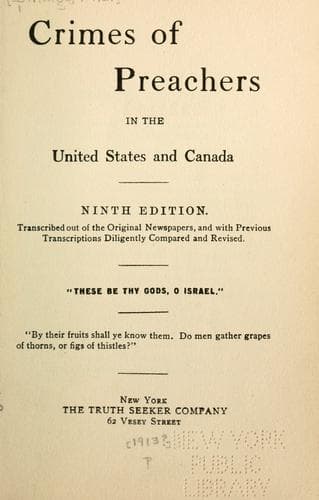
Crimes of Preachers in the United States and CanadaBillings, M. E.
Religion
Crimes of Preachers in the United States and Canada
Billings, M. E.
Clergy -- Malpractice -- Canada; Clergy -- Malpractice -- United States; Criminals -- Canada; Criminals -- United States
"A cross-roads clergyman who runs away with his organist will
get more attention than a congressman who goes off with his
stenographer. The senile philanderings of a former United States
senator did not get a front-page position so often as did a
comparatively obscure clergyman who a few years ago failed to
get gold out of sea-water, but did get it out of the purses of
customers who thought they had a 'good thing.' Why? The answer
throws a flood of light upon the question at issue. Because out
of tens of thousands of ministers, all of them working under the
obvious limitations and temptations to which the article makes
reference, those who go wrong are so few that, when such instances
occur, they are played up, because they are news. When a lawyer
or a physician, or a bank president, or a commercial traveler
is found with the broken fragments of the seventh commandment on
his person, it is no news, at least relatively speaking, and it
is given an inside page. This is an unconscious tribute of the
sensational press to the high estimate in which the clerical
profession is in general held."
The theory of the religious editor might account for the notoriety
given a delinquent minister, but no amount of publicity could create
the fact of his delinquency. He has to run off with his organist before
the yellow journal chronicles the event. And if more publicity is given
him than is received by the lawyer, physician and bank president when
the facts come out, the notoriety in known cases is more than offset
by the secrecy preserved by the minister's congregation and friends
in nine cases out of ten, so that the papers never get hold of the
matter at all.
But the defense based on extraordinary notoriety breaks down when we
remember that the preacher who wrote the article we reproduce does not
depend on the press for his knowledge of the clerical character. He has
first-hand information of his own, and makes the assertion, moreover,
that "it would be hard to find a man or a woman who has not at some
time in life become personally acquainted with a professed exponent of
religious truth and high moral ideals who has demonstrated the depths
of human depravity." This may or may not be an exaggeration; it agrees,
however, with the testimony of purchasers of the previous editions of
this pamphlet, who generally fail to find in its pages certain cases of
clerical depravity they have individually met. And we do not suppose
that one act of immorality in a thousand committed by clergymen is
ever known to anyone but himself. Not regarding ministers as worse
than other men in this respect, we may yet reasonably conclude that
they practice the customary male reserve, and therefore are no more
given to relating all the incidents of their lives--the only way such
incidents could become known--than members of the laity.
Public-domain text, read in full here on John Shaqi.
Reviews
Reviews
No reviews yet
Be the first to share your thoughts on this work.
Join the Discussion
Join the discussion
Sign in to leave a comment or review.
Sign InorCreate an account