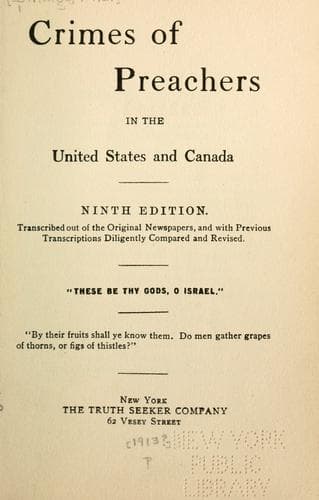
Crimes of Preachers in the United States and CanadaBillings, M. E.
Religion
Crimes of Preachers in the United States and Canada
Billings, M. E.
Clergy -- Malpractice -- Canada; Clergy -- Malpractice -- United States; Criminals -- Canada; Criminals -- United States
The indictment really is not against the ministers as men--it is
against their religion and their profession. There is so close a
relation between religious emotion and what is called desire, that
scientific men have written treatises and books on the correlation
of religion and lust. The more fervent the preacher is godward, the
more ardent is he womanward--and piety works the same way with the
sisters. Our preacher who has turned state's evidence blames among
other things the pastoral visit and the emotional women who place
temptation before the man of God. He is concerned only with the
minister, but the minister is as often a tempter as a victim. He
improves the opportunities the pastoral visit affords, and makes
his share of the advances. It may be that only men without mental
honesty--men who are willing to profess to believe and to teach what
they feel is false--are entering the ministry. In that case the worst
is to be expected, and their conduct is accounted for by their lack of
principle. The "Standard's" contributor offers the novel excuse that
the minister uses up so much of his virtue in phrasing and uttering
moral precepts that he has no strength left for applying them. The
proposition is worth the notice of the churches; for if true it means
that the vocation of a preacher devitalizes a man of his moral stamina.
The religious editor and his contributor disagree on an important
point. The editor holds that the fuss made over one minister who goes
wrong with his organist is a tribute to the high estimate in which
the profession is held. On the other hand, the contributor represents
that most ministers are moral skates, and that any high estimate the
profession enjoys is due to the few decent exceptions. The distinction
is vital.
The orthodox religious standards to which a minister is supposed to
measure up are admittedly responsible for much moral laxity. Besides
the sincerely orthodox preacher (whose religious austerity never
prevents him from erring sexually), there are thousands of ministers
who live a mental or intellectual lie by remaining in the church
and preaching the creeds they do not believe. And the church does
not trouble itself about the minister's doubts so long as he keeps
them to himself. What can the church expect, then, from the religious
hypocrite in the pulpit except that he will be a moral hypocrite out
of it? Is he going to be dishonest as a preacher and honest as a man?
The Baptist paper's contributor puts the query: "Do ministers of
the churches, that is, clergymen, priests and preachers, go wrong
in any greater proportion than do doctors, lawyers or teachers?" He
gives a negative answer, "mathematically," but the very asking of the
question proves that an affirmative reply was not unexpected. Had he
included editors in his list it could have been given. The literary
and editorial professions are very poorly represented in our prisons,
and even printers are exceedingly scarce.
Public-domain text, read in full here on John Shaqi.
Reviews
Reviews
No reviews yet
Be the first to share your thoughts on this work.
Join the Discussion
Join the discussion
Sign in to leave a comment or review.
Sign InorCreate an account