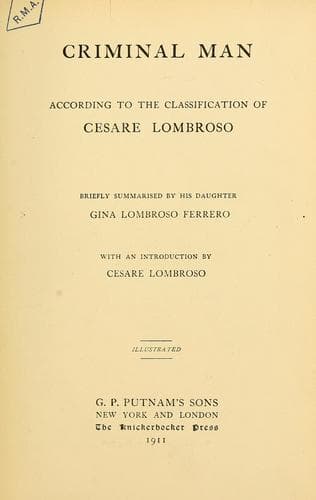
Criminal Man, According to the Classification of Cesare LombrosoLombroso, Gina
Science
Criminal Man, According to the Classification of Cesare Lombroso
Lombroso, Gina
Criminal anthropology; Criminology
All offenders, except the most degenerate types, born criminals or the
morally insane, desire work or occupation of some kind, and books of an
interesting character. This demand emanates from innumerable
inscriptions on the walls of cells and the margins of prison books: "How
unbearable is enforced idleness for a man who has always been
accustomed to work and study, and in whom activity and the desire of
some ennobling pursuit are not quite extinct!" ... "The nun of Cracow
cried, 'Bread, bread!' but my voice pleads from my solitary cell, 'Work,
work!'"
"If jurists would leave their desks and libraries," says my father in
conclusion, "put aside all pre-conceived notions, enter the prisons and
study the problem of criminality not on the walls of the cells, but on
the living documents they enclose, they would speedily realise that all
reforms evolved and applied without the aid of practical experience are
only dangerous illusions."
VII
_Ancient and Modern Crimes_ (_Delitti Vecchi e Delitti Nuovi_)
"This volume contains a collection of facts, sometimes valuable, at
other times merely curious, that I was able to glean during long years
of study in the field of criminal anthropology and psychiatry. They all
tend to show the great difference that exists between ancient and modern
crimes."
With these words my father begins the preface to this book, in which
cases of recent crimes are described and compared with those committed
in by-gone ages.
It is divided into three parts. The first part contains a comparative
and statistical study of criminality in Europe, Mexico, the United
States, and Australia.
The second part describes the careers of typical criminals of former
times, such as the Tozzis of Rome, a family of anthropophagous
criminals, and Vacher, Ballor, and other assassins of the
Jack-the-Ripper type, whose perverted sexual instincts prompted them to
murder a number of women and mutilate the corpses in a horrible fashion.
The third part treats of those modern criminals, like Holmes and Peace,
who accomplish their misdeeds in a refined and elegant manner,
substituting for the more brutal knife or hammer, the resources of
chemistry, physics, and modern toxicology. In other cases, some product
of modern times, such as the motor-car or bicycle, forms the motive for
the crime, or is of assistance in its accomplishment.
"From the data we have been able to gather relating to crime in by-gone
ages," continues my father in his preface, "we are led to conclude that
crimes of a violent and bloody nature predominated exclusively in more
barbarous times, and that fraudulent offences are characteristic of
modern communities. Violence is more primitive than trickery and must
always precede it, exactly as a more barbarous state in which property
is gained or maintained by force, at the point of the sword, precedes a
state in which ownership is regulated by means of contracts; and crime
always adapts itself to the prevailing customs.
Public-domain text, read in full here on John Shaqi.
Reviews
Reviews
No reviews yet
Be the first to share your thoughts on this work.
Elsewhere in the archive
Join the Discussion
Join the discussion
Sign in to leave a comment or review.
Sign InorCreate an account