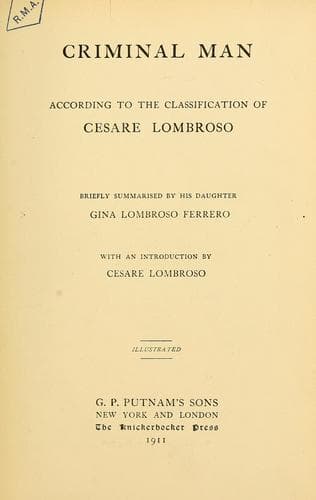
Criminal Man, According to the Classification of Cesare LombrosoLombroso, Gina
Science
Criminal Man, According to the Classification of Cesare Lombroso
Lombroso, Gina
Criminal anthropology; Criminology
"The admirable work of Coghlan shows criminality in Australia to be of
this latter type, as contrasted with its semi-barbarous nature in states
like Mexico, and gives us a picture of the character it will assume a
century or two later in Europe.
"As the fundamental nature of the criminal has not changed, his actions
are still of the same character; and violence and cunning are mingled or
alternate in modern crime. But though the individual remains unchanged,
he is subordinated to a more powerful factor than himself--modern
progress. It is true that many modern crimes are facilitated by modern
contrivances; but the same contrivances often furnish means for their
defeat; and so we may foresee a time, perhaps not very remote, when such
anti-social elements shall partially, if not totally, have disappeared."
VIII
_Diagnostic Methods of Legal Psychiatry_ (_La Perizia Psichiatrica
Legale_)
This work was not intended to introduce the doctrines of modern
criminology to the general public, but as a text-book for the guidance
of jurists, doctors, experts--in short, all those whose professions
bring them, into contact with criminals.
It consists of two parts, the first of which contains about fifty cases
diagnosed according to the new methods, and collected by the author of
the work and his followers. These cases include all types of
delinquents: born criminals, morally insane individuals, hysterical,
insane, inebriate, and epileptic criminals, criminaloids, criminals of
passion, etc.
In each case, as the diagnosis was intended to serve a practical
purpose, the criminal is examined physically, psychologically, and
psychiatrically; and his antecedents are investigated with great care.
In the second part, "The Technical Aspect of Criminal Anthropology," a
detailed description is given of the methods to be employed in the
examination of a supposed criminal, the rules for determining to what
class he belongs, the manner in which the physical examination should be
conducted, a list of the necessary measurements, a description of the
most suitable apparatus, and the mode of using them, the methods of
procedure in the interrogation of a criminal, in order to elicit useful
information, and instructions for analysing his intellectual
manifestations (handwriting, drawing, and work), movements, attitude,
and gestures.
Thanks to the methodical instruction imparted by this book, the
inexperienced student is enabled to progress gradually until he is in a
position to conduct a complete psychiatric and medico-legal examination.
The third part treats of the methods for discriminating between
criminals and lunatics. The various forms of mental alienation are
described in detail; and an examination of cases of feigned insanity
shows that simulators of lunacy are generally mentally unsound.
In the concluding part are discussed the various uses to which a careful
diagnosis may be applied.
Public-domain text, read in full here on John Shaqi.
Reviews
Reviews
No reviews yet
Be the first to share your thoughts on this work.
Elsewhere in the archive
Join the Discussion
Join the discussion
Sign in to leave a comment or review.
Sign InorCreate an account