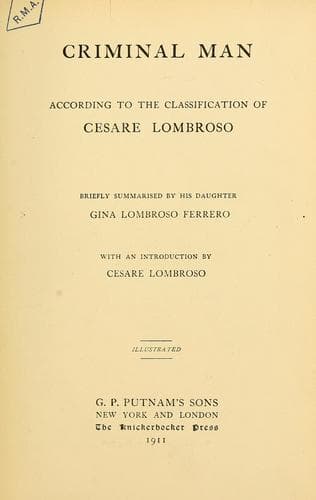
Criminal Man, According to the Classification of Cesare LombrosoLombroso, Gina
Science
Criminal Man, According to the Classification of Cesare Lombroso
Lombroso, Gina
Criminal anthropology; Criminology
_Impulsiveness._ This is another and almost pathognomonical
characteristic of born criminals, and also, as we shall see later on, of
epileptics and the morally insane. That which in ordinary individuals is
only an eccentric and fugitive suggestion vanishing as soon as it
arises, in the case of abnormal subjects is rapidly translated into
action, which, although unconscious, is not the less dangerous. A youth
of this impulsive type, returning home one evening flushed with wine,
met a peasant leading his ass and cried out, "As I have not come to
blows with anyone to-day, I must vent my rage on this beast," at the
same time drawing his knife and plunging it several times into the poor
animal's body (Ladelci, _Il Vino_, Rome, 1868). Pinel describes a
morally insane subject, who was in the habit of giving way to his
passions, killing any horses that did not please him and thrashing his
political opponents. He even went to the length of throwing a lady down
a well, because she ventured to contradict him.
"The most trifling causes [remarks Tamburini, speaking of Sbro...]
that stand in the way of his wishes, provoke a fit of rage in which
he appears to lose all self-control, like little children, who in
resenting any offence show no sense of proportion. The most trivial
reasons for disliking anyone awaken in him an irresistible desire
to kill the object of his aversion, and if any new blasphemy rises
to his lips, he feels constrained to repeat it."
A thief once said to my father: "It is in our very blood. It may be only
a pin, but I cannot help taking it, although I am quite ready to give it
back to its owner." The pickpocket Bor... confessed that at the age of
twelve he had begun to steal in the streets and at school, to the extent
of taking things from under his schoolfellows' pillows, and that it was
impossible for him to resist stealing, even when his pockets were full.
If he had not stolen some article before going to bed, he was unable to
sleep, and when midnight struck, he felt obliged to take the first thing
that came to his hand, destroying it frequently as soon as he had
appropriated it.
"To give up stealing," said Deham to Lauvergne, "would be like ceasing
to exist. Stealing is a passion that burns like love and when I feel the
blood seething in my brain and fingers, I think I should be capable of
robbing myself, if that were possible." When sentenced to the galleys,
he stole the bands from the masts, nails, and copper plates, and he
himself fixed the number of lashes he was to receive after each of these
exploits, which did not prevent his recommencing stealing directly
afterward (_Les Forçats_, p. 358).
Ponticelli once saw a thief, who was dying of consumption, steal an old
slipper from his neighbour and hide it under the bedclothes.
Public-domain text, read in full here on John Shaqi.
Reviews
Reviews
No reviews yet
Be the first to share your thoughts on this work.
Join the Discussion
Join the discussion
Sign in to leave a comment or review.
Sign InorCreate an account