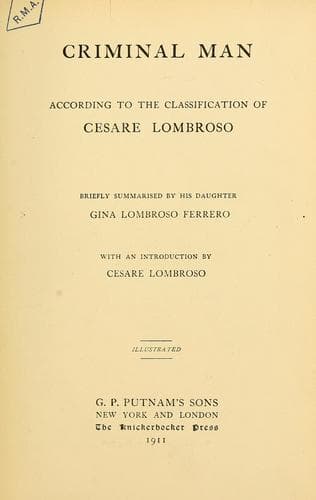
Criminal Man, According to the Classification of Cesare LombrosoLombroso, Gina
Science
Criminal Man, According to the Classification of Cesare Lombroso
Lombroso, Gina
Criminal anthropology; Criminology
_Treachery._ This species of morality and justice, which unexpectedly
makes its appearance in the midst of a naturally unrighteous community,
can only be forced and temporary. When, instead of reaping advantages,
interests and passions are injured by acting rightly, these notions of
justice, unsustained by innate integrity suddenly fail. Contrary to
universal belief, criminals are very prone to betray their companions
and accomplices, and are easily induced to act as informers in the hope
of gaining some personal advantage or of injuring those they envy or
suspect of treachery towards themselves.
"Many thieves," says Vidocq, "consider it a stroke of luck to be
consulted by the police." In fact, Bouscaut, one of a notorious band of
malefactors in France, was chiefly instrumental in causing the arrest of
the gang; and the brigand Caruso aided the authorities in capturing his
former companions.
_Vanity._ Pride, or rather vanity, and an exaggerated notion of their
own importance, which we find in the masses, generally in inverse
proportion to real merit, is especially strong in criminals. In the cell
occupied by La Gala, the following notice was found in his handwriting:
"March 24th. On this date La Gala learnt to knit." Another criminal,
Crocco, tried hard to save his brother, "Lest," he said, "my race should
die out." Lacenaire was less troubled by the death-sentence than by
adverse criticisms of his bad verse and the fear of public contempt. "I
do not fear being hated," he is reported to have said, "but I dread
being despised--the tempest leaves traces of its passage, but unobserved
the humble flower fades."
Thus thieves are loth to confess that they are guilty of only petty
larceny, and are sometimes prompted by vanity to commit more serious
robberies. The same false shame is common to fallen women, among whom
contempt is incurred, not by excess of depravity but by the failure to
command high prices. Grellinier, a petty thief, boasted in court of
imaginary offences, with the desire of appearing in the light of a great
criminal. The crimes in the haunted castle, attributed by Holmes to
himself, were certainly in part inventions. The female poisoner,
Buscemi, when writing to her accomplice, signed herself, "Your Lucrezia
Borgia."
One of the most frequent causes of modern crime is the desire to gratify
personal vanity and to become notorious.
Public-domain text, read in full here on John Shaqi.
Reviews
Reviews
No reviews yet
Be the first to share your thoughts on this work.
Join the Discussion
Join the discussion
Sign in to leave a comment or review.
Sign InorCreate an account