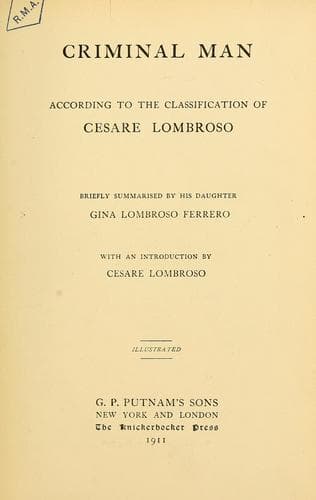
Criminal Man, According to the Classification of Cesare LombrosoLombroso, Gina
Science
Criminal Man, According to the Classification of Cesare Lombroso
Lombroso, Gina
Criminal anthropology; Criminology
The second inspiration came to me when on one occasion, amid the
laughter of my colleagues, I sought to base the study of psychiatry on
experimental methods. When in '66, fresh from the atmosphere of clinical
experiment, I had begun to study psychiatry, I realised how inadequate
were the methods hitherto held in esteem, and how necessary it was, in
studying the insane, to make the patient, not the disease, the object of
attention. In homage to these ideas, I applied to the clinical
examination of cases of mental alienation the study of the skull, with
measurements and weights, by means of the esthesiometer and craniometer.
Reassured by the result of these first steps, I sought to apply this
method to the study of criminals--that is, to the differentiation of
criminals and lunatics, following the example of a few investigators,
such as Thomson and Wilson; but as at that time I had neither criminals
nor moral imbeciles available for observation (a remarkable circumstance
since I was to make the criminal my starting-point), and as I was
skeptical as to the existence of those "moral lunatics" so much insisted
on by both French and English authors, whose demonstrations, however,
showed a lamentable lack of precision, I was anxious to apply the
experimental method to the study of the diversity, rather than the
analogy, between lunatics, criminals, and normal individuals. Like him,
however, whose lantern lights the road for others, while he himself
stumbles in the darkness, this method proved useless for determining the
differences between criminals and lunatics, but served instead to
indicate a new method for the study of penal jurisprudence, a matter to
which I had never given serious thought. I began dimly to realise that
the _a priori_ studies on crime in the abstract, hitherto pursued by
jurists, especially in Italy, with singular acumen, should be superseded
by the direct analytical study of the criminal, compared with normal
individuals and the insane.
I, therefore, began to study criminals in the Italian prisons, and,
amongst others, I made the acquaintance of the famous brigand Vilella.
This man possessed such extraordinary agility, that he had been known to
scale steep mountain heights bearing a sheep on his shoulders. His
cynical effrontery was such that he openly boasted of his crimes. On his
death one cold grey November morning, I was deputed to make the
_post-mortem_, and on laying open the skull I found on the occipital
part, exactly on the spot where a spine is found in the normal skull, a
distinct depression which I named _median occipital fossa_, because of
its situation precisely in the middle of the occiput as in inferior
animals, especially rodents. This depression, as in the case of animals,
was correlated with the hypertrophy of the _vermis_, known in birds as
the middle cerebellum.
Public-domain text, read in full here on John Shaqi.
Reviews
Reviews
No reviews yet
Be the first to share your thoughts on this work.
Join the Discussion
Join the discussion
Sign in to leave a comment or review.
Sign InorCreate an account