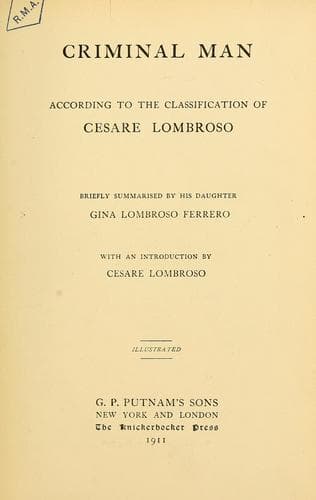
Criminal Man, According to the Classification of Cesare Lombroso — John Shaqi
Criminal Man, According to the Classification of Cesare LombrosoLombroso, Gina
Science
Criminal Man, According to the Classification of Cesare Lombroso
Lombroso, Gina
Criminal anthropology; Criminology
This was not merely an idea, but a revelation. At the sight of that
skull, I seemed to see all of a sudden, lighted up as a vast plain
under a flaming sky, the problem of the nature of the criminal--an
atavistic being who reproduces in his person the ferocious instincts of
primitive humanity and the inferior animals. Thus were explained
anatomically the enormous jaws, high cheek-bones, prominent superciliary
arches, solitary lines in the palms, extreme size of the orbits,
handle-shaped or sessile ears found in criminals, savages, and apes,
insensibility to pain, extremely acute sight, tattooing, excessive
idleness, love of orgies, and the irresistible craving for evil for its
own sake, the desire not only to extinguish life in the victim, but to
mutilate the corpse, tear its flesh, and drink its blood.
I was further encouraged in this bold hypothesis by the results of my
studies on Verzeni, a criminal convicted of sadism and rape, who showed
the cannibalistic instincts of primitive anthropophagists and the
ferocity of beasts of prey.
The various parts of the extremely complex problem of criminality were,
however, not all solved hereby. The final key was given by another case,
that of Misdea, a young soldier of about twenty-one, unintelligent but
not vicious. Although subject to epileptic fits, he had served for some
years in the army when suddenly, for some trivial cause, he attacked and
killed eight of his superior officers and comrades. His horrible work
accomplished, he fell into a deep slumber, which lasted twelve hours and
on awaking appeared to have no recollection of what had happened.
Misdea, while representing the most ferocious type of animal,
manifested, in addition, all the phenomena of epilepsy, which appeared
to be hereditary in all the members of his family. It flashed across my
mind that many criminal characteristics not attributable to atavism,
such as facial asymmetry, cerebral sclerosis, impulsiveness,
instantaneousness, the periodicity of criminal acts, the desire of evil
for evil's sake, were morbid characteristics common to epilepsy, mingled
with others due to atavism.
Thus were traced the first clinical outlines of my work which had
hitherto been entirely anthropological. The clinical outlines confirmed
the anthropological contours, and _vice versâ_; for the greatest
criminals showed themselves to be epileptics, and, on the other hand,
epileptics manifested the same anomalies as criminals. Finally, it was
shown that epilepsy frequently reproduced atavistic characteristics,
including even those common to lower animals.
Public-domain text, read in full here on John Shaqi.
Reviews
Reviews
No reviews yet
Be the first to share your thoughts on this work.
Join the Discussion
Join the discussion
Sign in to leave a comment or review.
Sign InorCreate an account