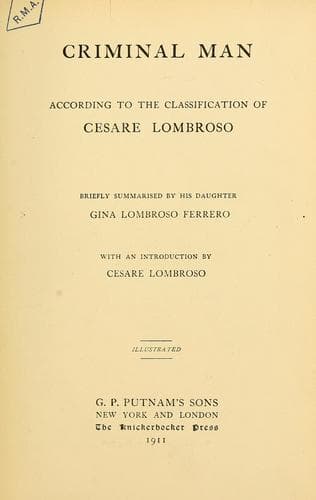
Criminal Man, According to the Classification of Cesare LombrosoLombroso, Gina
Science
Criminal Man, According to the Classification of Cesare Lombroso
Lombroso, Gina
Criminal anthropology; Criminology
That synthesis which mighty geniuses have often succeeded in creating by
one inspiration (but at the risk of errors, for a genius is only human
and in many cases more fallacious than his fellow-men) was deduced by
me gradually from various sources--the study of the normal individual,
the lunatic, the criminal, the savage, and finally the child. Thus, by
reducing the penal problem to its simplest expression, its solution was
rendered easier, just as the study of embryology has in a great measure
solved the apparently strange and mysterious riddle of teratology.
But these attempts would have been sterile, had not a solid phalanx of
jurists, Russian, German, Hungarian, Italian, and American, fertilised
the germ by correcting hasty and one-sided conclusions, suggesting
opportune reforms and applications, and, most important of all, applying
my ideas on the offender to his individual and social prophylaxis and
cure.
Enrico Ferri was the first to perceive that the congenital epileptoid
criminal did not form a single species, and that if this class was
irretrievably doomed to perdition, crime in others was only a brief
spell of insanity, determined by circumstances, passion, or illness. He
established new types--the occasional criminal and the criminal by
passion,--and transformed the basis of the penal code by asking if it
were more just to make laws obey facts instead of altering facts to suit
the laws, solely in order to avoid troubling the placidity of those who
refused to consider this new element in the scientific field. Therefore,
putting aside those abstract formulæ for which high talents have panted
in vain, like the thirsty traveller at the sight of the desert mirage,
the advocates of the Modern School came to the conclusion that sentences
should show a decrease in infamy and ferocity proportionate to the
increase in length and social safety. In lieu of infamy they substituted
a longer period of segregation, and for cases in which alienists were
unable to decide between criminality and insanity, they advocated an
intermediate institution, in which merciful treatment and social
security were alike considered. They also emphasised the importance of
certain measures which hitherto had been universally regarded as a pure
abstraction or an unattainable desideratum--measures for the prevention
of crime by tracing it to its source, divorce laws to diminish adultery,
legislation of an anti-alcoholistic tendency to prevent crimes of
violence, associations for destitute children, and co-operative
associations to check the tendency to theft. Above all, they insisted on
those regulations--unfortunately fallen into disuse--which indemnify the
victim at the expense of the aggressor, in order that society, having
suffered once for the crime, should not be obliged to suffer
pecuniarily for the detention of the offender, solely in homage to a
theoretical principle that no one believes in, according to which prison
Public-domain text, read in full here on John Shaqi.
Reviews
Reviews
No reviews yet
Be the first to share your thoughts on this work.
Join the Discussion
Join the discussion
Sign in to leave a comment or review.
Sign InorCreate an account