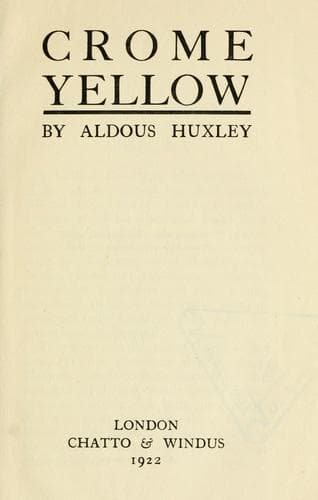
Country homes -- Fiction; England -- Fiction; Humorous stories; Intellectuals -- Fiction; Satire
Becoming once more aware of the outer world, he found himself on the
crest of a descent. The road plunged down, steep and straight, into a
considerable valley. There, on the opposite slope, a little higher up
the valley, stood Crome, his destination. He put on his brakes; this
view of Crome was pleasant to linger over. The facade with its three
projecting towers rose precipitously from among the dark trees of the
garden. The house basked in full sunlight; the old brick rosily glowed.
How ripe and rich it was, how superbly mellow! And at the same time, how
austere! The hill was becoming steeper and steeper; he was gaining
speed in spite of his brakes. He loosed his grip of the levers, and in
a moment was rushing headlong down. Five minutes later he was passing
through the gate of the great courtyard. The front door stood hospitably
open. He left his bicycle leaning against the wall and walked in. He
would take them by surprise.
CHAPTER II.
He took nobody by surprise; there was nobody to take. All was quiet;
Denis wandered from room to empty room, looking with pleasure at the
familiar pictures and furniture, at all the little untidy signs of life
that lay scattered here and there. He was rather glad that they were
all out; it was amusing to wander through the house as though one
were exploring a dead, deserted Pompeii. What sort of life would the
excavator reconstruct from these remains; how would he people these
empty chambers? There was the long gallery, with its rows of respectable
and (though, of course, one couldn’t publicly admit it) rather boring
Italian primitives, its Chinese sculptures, its unobtrusive, dateless
furniture. There was the panelled drawing-room, where the huge
chintz-covered arm-chairs stood, oases of comfort among the austere
flesh-mortifying antiques. There was the morning-room, with its pale
lemon walls, its painted Venetian chairs and rococo tables, its mirrors,
its modern pictures. There was the library, cool, spacious, and dark,
book-lined from floor to ceiling, rich in portentous folios. There was
the dining-room, solidly, portwinily English, with its great
mahogany table, its eighteenth-century chairs and sideboard, its
eighteenth-century pictures--family portraits, meticulous animal
paintings. What could one reconstruct from such data? There was much of
Henry Wimbush in the long gallery and the library, something of Anne,
perhaps, in the morning-room. That was all. Among the accumulations of
ten generations the living had left but few traces.
Lying on the table in the morning-room he saw his own book of poems.
What tact! He picked it up and opened it. It was what the reviewers call
“a slim volume.” He read at hazard:
”...But silence and the topless dark
Vault in the lights of Luna Park;
And Blackpool from the nightly gloom
Hollows a bright tumultuous tomb.”
Public-domain text, read in full here on John Shaqi.
Reviews
Reviews
No reviews yet
Be the first to share your thoughts on this work.
Join the Discussion
Join the discussion
Sign in to leave a comment or review.
Sign InorCreate an account