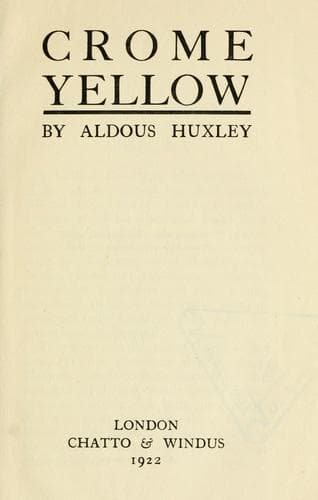
Country homes -- Fiction; England -- Fiction; Humorous stories; Intellectuals -- Fiction; Satire
He put it down again, shook his head, and sighed. “What genius I had
then!” he reflected, echoing the aged Swift. It was nearly six months
since the book had been published; he was glad to think he would never
write anything of the same sort again. Who could have been reading it,
he wondered? Anne, perhaps; he liked to think so. Perhaps, too, she had
at last recognised herself in the Hamadryad of the poplar sapling; the
slim Hamadryad whose movements were like the swaying of a young tree in
the wind. “The Woman who was a Tree” was what he had called the poem. He
had given her the book when it came out, hoping that the poem would tell
her what he hadn’t dared to say. She had never referred to it.
He shut his eyes and saw a vision of her in a red velvet cloak, swaying
into the little restaurant where they sometimes dined together in
London--three quarters of an hour late, and he at his table, haggard
with anxiety, irritation, hunger. Oh, she was damnable!
It occurred to him that perhaps his hostess might be in her boudoir. It
was a possibility; he would go and see. Mrs. Wimbush’s boudoir was in
the central tower on the garden front. A little staircase cork-screwed
up to it from the hall. Denis mounted, tapped at the door. “Come in.”
Ah, she was there; he had rather hoped she wouldn’t be. He opened the
door.
Priscilla Wimbush was lying on the sofa. A blotting-pad rested on her
knees and she was thoughtfully sucking the end of a silver pencil.
“Hullo,” she said, looking up. “I’d forgotten you were coming.”
“Well, here I am, I’m afraid,” said Denis deprecatingly. “I’m awfully
sorry.”
Mrs. Wimbush laughed. Her voice, her laughter, were deep and masculine.
Everything about her was manly. She had a large, square, middle-aged
face, with a massive projecting nose and little greenish eyes, the whole
surmounted by a lofty and elaborate coiffure of a curiously improbable
shade of orange. Looking at her, Denis always thought of Wilkie Bard as
the cantatrice.
“That’s why I’m going to
Sing in op’ra, sing in op’ra,
Sing in op-pop-pop-pop-pop-popera.”
Today she was wearing a purple silk dress with a high collar and a row
of pearls. The costume, so richly dowagerish, so suggestive of the Royal
Family, made her look more than ever like something on the Halls.
“What have you been doing all this time?” she asked.
“Well,” said Denis, and he hesitated, almost voluptuously. He had a
tremendously amusing account of London and its doings all ripe and ready
in his mind. It would be a pleasure to give it utterance. “To begin
with,” he said...
But he was too late. Mrs. Wimbush’s question had been what the
grammarians call rhetorical; it asked for no answer. It was a little
conversational flourish, a gambit in the polite game.
“You find me busy at my horoscopes,” she said, without even being aware
that she had interrupted him.
Public-domain text, read in full here on John Shaqi.
Reviews
Reviews
No reviews yet
Be the first to share your thoughts on this work.
Join the Discussion
Join the discussion
Sign in to leave a comment or review.
Sign InorCreate an account