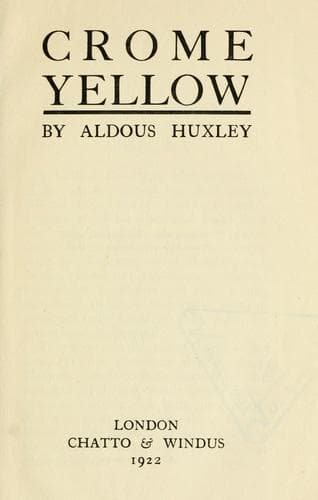
Country homes -- Fiction; England -- Fiction; Humorous stories; Intellectuals -- Fiction; Satire
“Rum; Tum; Rum-ti-ti; Tum-ti-ti...”
The melody wallowed oozily along, like a ship moving forward over a
sleek and oily swell. The four-legged creature, more graceful, more
harmonious in its movements than ever, slid across the floor. Oh, why
was he born with a different face?
“What are you reading?”
He looked up, startled. It was Mary. She had broken from the
uncomfortable embrace of Mr. Scogan, who had now seized on Jenny for his
victim.
“What are you reading?”
“I don’t know,” said Denis truthfully. He looked at the title page; the
book was called “The Stock Breeder’s Vade Mecum.”
“I think you are so sensible to sit and read quietly,” said Mary, fixing
him with her china eyes. “I don’t know why one dances. It’s so boring.”
Denis made no reply; she exacerbated him. From the arm-chair by the
fireplace he heard Priscilla’s deep voice.
“Tell me, Mr Barbecue-Smith--you know all about science, I know--” A
deprecating noise came from Mr. Barbecue-Smith’s chair. “This Einstein
theory. It seems to upset the whole starry universe. It makes me so
worried about my horoscopes. You see...”
Mary renewed her attack. “Which of the contemporary poets do you like
best?” she asked. Denis was filled with fury. Why couldn’t this pest of
a girl leave him alone? He wanted to listen to the horrible music, to
watch them dancing--oh, with what grace, as though they had been made
for one another!--to savour his misery in peace. And she came and put
him through this absurd catechism! She was like “Mangold’s Questions”:
“What are the three diseases of wheat?”--“Which of the contemporary
poets do you like best?”
“Blight, Mildew, and Smut,” he replied, with the laconism of one who is
absolutely certain of his own mind.
It was several hours before Denis managed to go to sleep that night.
Vague but agonising miseries possessed his mind. It was not only Anne
who made him miserable; he was wretched about himself, the future, life
in general, the universe. “This adolescence business,” he repeated to
himself every now and then, “is horribly boring.” But the fact that he
knew his disease did not help him to cure it.
After kicking all the clothes off the bed, he got up and sought relief
in composition. He wanted to imprison his nameless misery in words. At
the end of an hour, nine more or less complete lines emerged from among
the blots and scratchings.
“I do not know what I desire
When summer nights are dark and still,
When the wind’s many-voiced quire
Sleeps among the muffled branches.
I long and know not what I will:
And not a sound of life or laughter stanches
Time’s black and silent flow.
I do not know what I desire,
I do not know.”
He read it through aloud; then threw the scribbled sheet into the
waste-paper basket and got into bed again. In a very few minutes he was
asleep.
CHAPTER XI.
Public-domain text, read in full here on John Shaqi.
Reviews
Reviews
No reviews yet
Be the first to share your thoughts on this work.
Join the Discussion
Join the discussion
Sign in to leave a comment or review.
Sign InorCreate an account