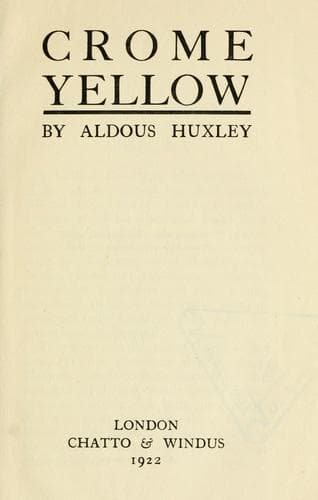
Country homes -- Fiction; England -- Fiction; Humorous stories; Intellectuals -- Fiction; Satire
Mr. Barbecue-Smith was gone. The motor had whirled him away to the
station; a faint smell of burning oil commemorated his recent departure.
A considerable detachment had come into the courtyard to speed him on
his way; and now they were walking back, round the side of the house,
towards the terrace and the garden. They walked in silence; nobody had
yet ventured to comment on the departed guest.
“Well?” said Anne at last, turning with raised inquiring eyebrows to
Denis.
“Well?” It was time for someone to begin.
Denis declined the invitation; he passed it on to Mr Scogan. “Well?” he
said.
Mr. Scogan did not respond; he only repeated the question, “Well?”
It was left for Henry Wimbush to make a pronouncement. “A very agreeable
adjunct to the week-end,” he said. His tone was obituary.
They had descended, without paying much attention where they were going,
the steep yew-walk that went down, under the flank of the terrace, to
the pool. The house towered above them, immensely tall, with the whole
height of the built-up terrace added to its own seventy feet of
brick façade. The perpendicular lines of the three towers soared up,
uninterrupted, enhancing the impression of height until it became
overwhelming. They paused at the edge of the pool to look back.
“The man who built this house knew his business,” said Denis. “He was an
architect.”
“Was he?” said Henry Wimbush reflectively. “I doubt it. The builder of
this house was Sir Ferdinando Lapith, who flourished during the reign of
Elizabeth. He inherited the estate from his father, to whom it had been
granted at the time of the dissolution of the monasteries; for Crome was
originally a cloister of monks and this swimming-pool their fish-pond.
Sir Ferdinando was not content merely to adapt the old monastic
buildings to his own purposes; but using them as a stone quarry for his
barns and byres and outhouses, he built for himself a grand new house of
brick--the house you see now.”
He waved his hand in the direction of the house and was silent, severe,
imposing, almost menacing, Crome loomed down on them.
“The great thing about Crome,” said Mr. Scogan, seizing the opportunity
to speak, “is the fact that it’s so unmistakably and aggressively a work
of art. It makes no compromise with nature, but affronts it and
rebels against it. It has no likeness to Shelley’s tower, in the
‘Epipsychidion,’ which, if I remember rightly--“
“‘Seems not now a work of human art,
But as it were titanic, in the heart
Of earth having assumed its form and grown
Out of the mountain, from the living stone,
Lifting itself in caverns light and high.’
Public-domain text, read in full here on John Shaqi.
Reviews
Reviews
No reviews yet
Be the first to share your thoughts on this work.
Join the Discussion
Join the discussion
Sign in to leave a comment or review.
Sign InorCreate an account