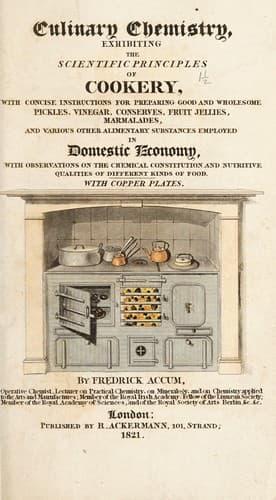
Culinary Chemistry: The Scientific Principles of Cookery, with Concise Instructions for Preparing Good and Wholesome Pickles, Vinegar, Conserves, Fruit Jellies, Marmalades, and Various Other Alimentary Substances Employed in Domestic Economy, with Observations on the Chemical Constitution and Nutritive Qualities of Different Kinds of Food.Accum, Friedrich Christian
Science
Culinary Chemistry: The Scientific Principles of Cookery, with Concise Instructions for Preparing Good and Wholesome Pickles, Vinegar, Conserves, Fruit Jellies, Marmalades, and Various Other Alimentary Substances Employed in Domestic Economy, with Observations on the Chemical Constitution and Nutritive Qualities of Different Kinds of Food.
Accum, Friedrich Christian
Cooking; Food poisoning
“_The Irishman_ loves usquebah,
_The Scot_ loves ale called blue cap,
_The Welshman_, he loves toasted cheese,
And makes his mouth like a mouse trap.”
APICIUS,[8] among other whimsical personages of ancient Rome, presented
to his guests ragouts, exclusively composed of tongues of peacocks and
nightingales. This celebrated epicure, who instituted a gormandizing
academy at Rome, having heard that shrimps and prawns of a superior
flavour were to be met with on the coasts of Africa than on the Italian
shore, freighted a ship, and sailed in search of these far famed marine
insects. This person spent more than £.60,000 merely to vary the taste
of culinary sauces.
[8] Three brothers of that name were celebrated at Rome, on account of
their unparallelled love of good eating.
Vitellus was treated by his brother with a dinner, consisting of 2,000
dishes of fish, and 7,000 of poultry--surely this is not doing things by
halves.
A Mr. Verditch de Bourbonne[9] is said to have bought 3,000 carps for
the mere sake of their tongues, which were brought, well seasoned and
_learnedly_ dressed, to his table, in one dish.
[9] Cours Gastronomique.
DIFFERENCE BETWEEN AN EPICURE AND A GLUTTON.
However extravagant and whimsical the rational pleasures of the table
may appear to a _sober_ and sensible mind, we must, in justice to
epicures, cursorily observe, that there exists a material difference
between a _gormand_ or epicure, and a _glutton_.[10] The first seeks for
peculiar delicacy and distinct flavour in the various dishes presented
to the judgment and enjoyment of his discerning palate; while the other
lays aside nearly all that relates to the rational pleasures of
creating or stimulating an appetite of the cates, and looks merely to
quantity; this, has his stomach in view, and tries how heavy it may be
laden, without endangering his health.
[10] _Tabella Cibaria_, a latin poem, relating to the pleasures of
Gastronomy, and the mysterious art of Cooking, page 15.
“The _gormand_ never loses sight of the exquisite organs of taste, so
admirably disposed by Providence in the crimson chamber, where sits the
discriminating judge, the human tongue.
“The _glutton_ is anathematised in the Scripture with those brutes
_quorum deus venter est_. The other appears guilty of no other sin than
of too great, and too minute, an attention to refinement in commercial
sensuality.”
Public-domain text, read in full here on John Shaqi.
Reviews
Reviews
No reviews yet
Be the first to share your thoughts on this work.
Join the Discussion
Join the discussion
Sign in to leave a comment or review.
Sign InorCreate an account