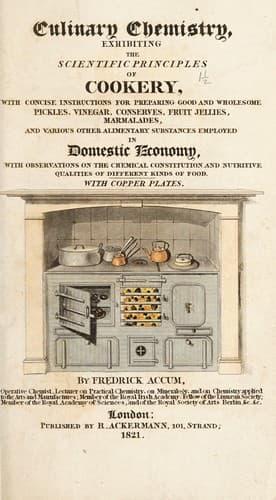
Culinary Chemistry: The Scientific Principles of Cookery, with Concise Instructions for Preparing Good and Wholesome Pickles, Vinegar, Conserves, Fruit Jellies, Marmalades, and Various Other Alimentary Substances Employed in Domestic Economy, with Observations on the Chemical Constitution and Nutritive Qualities of Different Kinds of Food. — John Shaqi
Culinary Chemistry: The Scientific Principles of Cookery, with Concise Instructions for Preparing Good and Wholesome Pickles, Vinegar, Conserves, Fruit Jellies, Marmalades, and Various Other Alimentary Substances Employed in Domestic Economy, with Observations on the Chemical Constitution and Nutritive Qualities of Different Kinds of Food.Accum, Friedrich Christian
Science
Culinary Chemistry: The Scientific Principles of Cookery, with Concise Instructions for Preparing Good and Wholesome Pickles, Vinegar, Conserves, Fruit Jellies, Marmalades, and Various Other Alimentary Substances Employed in Domestic Economy, with Observations on the Chemical Constitution and Nutritive Qualities of Different Kinds of Food.
Accum, Friedrich Christian
Cooking; Food poisoning
Our neighbours on the other side of the channel, so famous for indulging
in the worship of Comus, consider the epicure again under two distinct
views, namely: as a _gormand_, or a _gourmet_. The epicure or _gormand_
is defined--a man having accidentally been able to study the different
tastes of eatables, does accordingly select the best food and the most
pleasing to his palate. His character is that of a _practioner_. The
_gourmet_ speculates more than he practises, and eminently prides
himself in discerning the nicest degrees, and most evanescent shades of
goodness and perfection in the different subjects proposed to him. He
may be designated a man, who, by sipping a few drops out of the silver
cup of the vintner, can instantly tell from what country the wine comes,
and its age.
The _glutton_ practices without any regard to theory.
The _gormand_, or epicure, unites theory with practice.
The _gourmet_ is merely theoretical.
IMPORTANCE OF THE ART OF COOKERY.
As man differs from the inferior animals in the variety of articles he
feeds upon, so he differs from them no less in the preparation of these
substances. Some animals, besides man, prepare their food in a
particular manner. The racoon (_ursus lutor_) is said to wash his roots
before he eats them; and the beaver stores his green boughs under water
that their bark and young twigs may remain juicy and palatable.
The action of fire, however, has never been applied to use by any animal
except man; not even monkies, with all their knacks of imitation, and
all their fondness for the comforts of a fire, have ever been observed
to put on a single billet of wood to keep up the fuel.
Domesticated animals, indeed, are brought to eat, and even to relish,
food which has been cooked by the action of heat.
The variety of productions introduced by our different modes of
preparing and preserving food is almost endless; and it appears
particularly so when we compare the usages, in this respect, of various
countries.
The savage of New South Wales is scarcely more knowing in the
preparation of food, by means of fire, than his neighbour, the kangaroo,
if the anecdote told by Turnbull be true, that one of these savages
plunged his hand into boiling water to take out a fish.
Some writers have humorously designated man to be “_a cooking animal_,”
and he really is so. It is one of the leading distinctions which
Providence has seen meet for wise purposes to establish, when it was
said that he might eat of the fruit of every tree, and the flesh of
every clean beast.
When we contemplate the aliments used by men in a civilized state of
existence, we soon become convinced that only a small part of our daily
food can be eaten in its natural state. Many of the substances used as
aliments, are disagreeable, and some even poisonous until they have been
cooked. Few of them are to be had at all seasons, although produced at
others in greater abundance than can be consumed.
Public-domain text, read in full here on John Shaqi.
Reviews
Reviews
No reviews yet
Be the first to share your thoughts on this work.
Join the Discussion
Join the discussion
Sign in to leave a comment or review.
Sign InorCreate an account