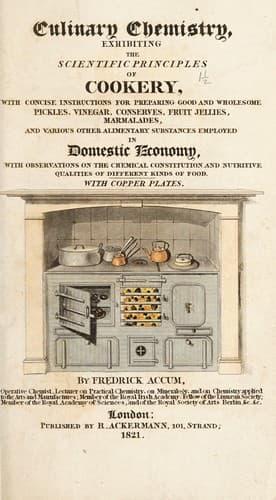
Culinary Chemistry: The Scientific Principles of Cookery, with Concise Instructions for Preparing Good and Wholesome Pickles, Vinegar, Conserves, Fruit Jellies, Marmalades, and Various Other Alimentary Substances Employed in Domestic Economy, with Observations on the Chemical Constitution and Nutritive Qualities of Different Kinds of Food.Accum, Friedrich Christian
Science
Culinary Chemistry: The Scientific Principles of Cookery, with Concise Instructions for Preparing Good and Wholesome Pickles, Vinegar, Conserves, Fruit Jellies, Marmalades, and Various Other Alimentary Substances Employed in Domestic Economy, with Observations on the Chemical Constitution and Nutritive Qualities of Different Kinds of Food.
Accum, Friedrich Christian
Cooking; Food poisoning
Another circumstance which produces difference of quality in flesh, is
the sex of the animal, the genital organs having in this respect a very
remarkable influence, as appears from the effect of destroying these by
castration. This renders the flesh of the male similar, and in some
cases, as in mutton, superior to that of the female, which is always
more tender, and of finer fibre than that of the uncastrated male. By
destroying also the ovaries of the females, their flesh is rendered more
delicate, though this operation is not often practised. The sow is the
animal which is most usually operated upon with this view; the flesh of
the uncastrated boar is very coarse and bad. Even in calves the
difference is observable, and veal is greatly improved by castrating the
males. The same practice greatly improves fowl, as in capons. Venison is
rank, tough, lean, and ill flavoured, and not fit to be eaten when
killed during the rutting season, in September and October; and salmon,
when about to spawn, are also bad, and prohibited, we believe, by our
laws, to be caught or sold.
The mode of feeding animals, designed for the table, has also great
influence on the quality of the flesh, so much so, that nice judges can
distinguish whether mutton, if from the same breed of sheep, has been
fed on grass or on turnips; and can tell, still more accurately, on
tasting the fat of pork, whether the pigs have been fed on sour skimmed
milk, brewers grains, or pease flour. It was the practice sometime ago,
but now almost laid aside, to feed calves and oxen on oil cake. This did
certainly fatten them, but the fat was rather rancid in most cases, and
never of good flavour. The truth seems to be, that, though generally,
the lean of fat animals is the most tender and palatable, yet that this
is not so much the case when the fat is rapidly produced by artificial
management in the feeding.
Sheep become very rapidly fat in the first stage of the rot, in
consequence, perhaps, of their desire for food being greatly increased
by the disease; and, taking advantage of this, it is said that some
butchers are in the practice of producing rot artificially, which is
certainly very blameable. Some amateurs of mutton are fond of such as
has died of a sort of colic, called in the North _braxy_, that produces
a very peculiar flavour in the meat, which is always, however, roasted,
and never stewed or boiled. Such tastes are, to say the least of them,
surely unnatural.
Public-domain text, read in full here on John Shaqi.
Reviews
Reviews
No reviews yet
Be the first to share your thoughts on this work.
Join the Discussion
Join the discussion
Sign in to leave a comment or review.
Sign InorCreate an account