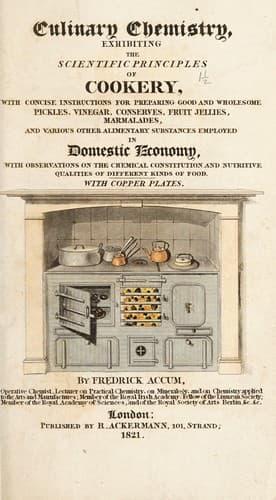
Culinary Chemistry: The Scientific Principles of Cookery, with Concise Instructions for Preparing Good and Wholesome Pickles, Vinegar, Conserves, Fruit Jellies, Marmalades, and Various Other Alimentary Substances Employed in Domestic Economy, with Observations on the Chemical Constitution and Nutritive Qualities of Different Kinds of Food. — John Shaqi
Culinary Chemistry: The Scientific Principles of Cookery, with Concise Instructions for Preparing Good and Wholesome Pickles, Vinegar, Conserves, Fruit Jellies, Marmalades, and Various Other Alimentary Substances Employed in Domestic Economy, with Observations on the Chemical Constitution and Nutritive Qualities of Different Kinds of Food.Accum, Friedrich Christian
Science
Culinary Chemistry: The Scientific Principles of Cookery, with Concise Instructions for Preparing Good and Wholesome Pickles, Vinegar, Conserves, Fruit Jellies, Marmalades, and Various Other Alimentary Substances Employed in Domestic Economy, with Observations on the Chemical Constitution and Nutritive Qualities of Different Kinds of Food.
Accum, Friedrich Christian
Cooking; Food poisoning
Appears to be the most ancient process of rendering animal food eatable
by means of the action of heat.
Spits were used very anciently in all parts of the world, and perhaps,
before the plain practice of hanging the meat to a string before the
fire. Ere the iron age had taught men the use of metals, these roasting
instruments were made of wood; and as we find it in Virgil,[20] slender
branches of the hazel tree were particularly chosen--
--------“_Stabit sacer hircus ad aram
“Pinguiaque in verubus torrebimus extra colurnis._”
The altar let the guilty goat approach,
And roast his fat limbs on the hazel broach.”
[20] Georgics II. 545.
Roasting is the most simple and direct application of heat in the
preparation of food. The process is, for the most part, confined to
animal substances, though several fruits, such as apples, chesnuts, and
some roots, are in this manner directly subjected to fire.
But in dressing animal food, butcher’s meat, venison, fowl, and fish,
roasting is one of the most usual processes, and it is, we believe, the
best for rendering food nutritive and wholesome. The chemical changes
also which roasting induces, are sufficiently slight, as a careful
analysis will procure from meat, properly roasted, nearly all the
elements which are to be found in it in the raw state. Slight as the
change is however in a chemical, it is considerable in a culinary, point
of view. The texture of the meat is more relaxed and consequently it is
more tender; it is also more sapid and high flavoured. It is absolutely
essential that the meat intended for roasting, has been kept long enough
for the fibres to become flaccid, without which precaution the best meat
does not become tender. If the meat be frozen, it should be thawed, by
putting it into cold water, before it is put on the spit.
The process of roasting requires some care to conduct it properly. The
meat should be gradually turned before the fire, in order to effect its
uniform exposure to the rays of heat. A covering of paper prevents the
fat from taking fire, and frequently _basting_ the meat with gravy or
melted fat, prevents it from being scorched or becoming dry, bitter, and
unpalatable. It is necessary to be very careful in placing the meat to
be roasted at a proper distance from the fire. If it is put too near,
the surface will be scorched and burnt to a cinder, while the inner
portion will be quite raw; and, if it be too distant, it will never have
either the tenderness or the flavour it would have had by proper care.
At first, it should be placed at some distance, and afterwards be
gradually brought nearer the fire, to give the heat time to penetrate
the whole piece equally; and, the larger the joint is, the more
gradually should this be done. Poultry, in particular, should be heated
very gradually.
When the joint is of an unequal thickness, the spit must be placed
slanting, so that the thinnest part is further removed from the fire.
Public-domain text, read in full here on John Shaqi.
Reviews
Reviews
No reviews yet
Be the first to share your thoughts on this work.
Join the Discussion
Join the discussion
Sign in to leave a comment or review.
Sign InorCreate an account