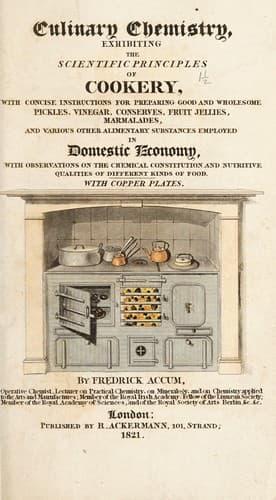
Culinary Chemistry: The Scientific Principles of Cookery, with Concise Instructions for Preparing Good and Wholesome Pickles, Vinegar, Conserves, Fruit Jellies, Marmalades, and Various Other Alimentary Substances Employed in Domestic Economy, with Observations on the Chemical Constitution and Nutritive Qualities of Different Kinds of Food.Accum, Friedrich Christian
Science
Culinary Chemistry: The Scientific Principles of Cookery, with Concise Instructions for Preparing Good and Wholesome Pickles, Vinegar, Conserves, Fruit Jellies, Marmalades, and Various Other Alimentary Substances Employed in Domestic Economy, with Observations on the Chemical Constitution and Nutritive Qualities of Different Kinds of Food.
Accum, Friedrich Christian
Cooking; Food poisoning
_Natural History of the Tea Tree_ 295
_Observations on the art of Making Tea, and singular effects of
different kinds of Tea Pots on the Infusion of Tea_ 299
_Japanese Method of Making Tea_ 301
Coffee.
_Natural History of the Coffee Tree_ 305
_Best Method of Making Coffee_ 308
Kitchen Fire-places, AND Cooking Utensils.
_Saucepans and Stew Pans_ 329
_Preserving Pans_ 330
_Copper Cooking Utensils_ 331
_Wooden Tubs_ 336
Cookery.
COOKERY IS A BRANCH OF CHEMICAL SCIENCE.
Cookery, or the art of preparing good and wholesome food, and of
preserving all sorts of alimentary substances in a state fit for human
sustenance, of rendering that agreeable to the taste which is essential
to the support of life, and of pleasing the palate without injury to the
system, is, strictly speaking, a branch of chemistry; but, important as
it is both to our enjoyments and our health, it is also one of the
least cultivated branches of that science. The culinary processes of
roasting, boiling, baking, stewing, frying, broiling, the art of
preserving meats, bacon, and hams; the preparations of sauces, pickles,
and other condiments; the conserving of fruits; the care and keeping of
vegetables; the making of jellies, jams, and marmalades, are all founded
upon the principles of this science, and much waste of the material, as
well as labour to the parties might often be spared, were those to whom
the performance of such tasks is committed, made acquainted with simple
chemical truths which would invariably lead to certain results. And,
besides, the same knowledge would enable them to attain a much greater
degree of perfection in curing and preserving all kinds of animal and
vegetable aliments, and in combining the three grand requisites of
taste, nutriment, and salubrity, in whatever manner they may be
prepared. And, though this art is at present in rude hands, as all
branches of chemistry were originally, there is no reason that it should
remain so. A kitchen is, in fact, a chemical laboratory; the boilers,
stew-pans, and cradle spit of the cook, correspond to the digestors, the
evaporating basins, and the crucibles of the chemist. And numerous as
the receipts of cookery are, the general operations (like the general
process of chemistry) are but few. In some the object aimed at is, to
extract the constituent parts of the food, so as to exhibit them in a
separate state, or to combine them with other substances, to produce new
compounds which differ widely from those from which they originated. In
others, the qualities of the substances are simply altered by the
Public-domain text, read in full here on John Shaqi.
Reviews
Reviews
No reviews yet
Be the first to share your thoughts on this work.
Join the Discussion
Join the discussion
Sign in to leave a comment or review.
Sign InorCreate an account