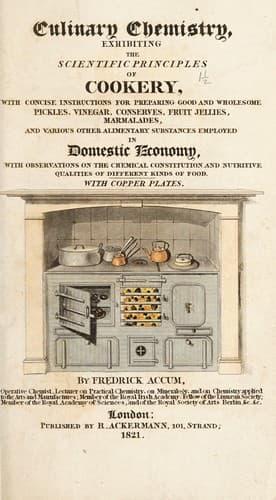
Culinary Chemistry: The Scientific Principles of Cookery, with Concise Instructions for Preparing Good and Wholesome Pickles, Vinegar, Conserves, Fruit Jellies, Marmalades, and Various Other Alimentary Substances Employed in Domestic Economy, with Observations on the Chemical Constitution and Nutritive Qualities of Different Kinds of Food.Accum, Friedrich Christian
Science
Culinary Chemistry: The Scientific Principles of Cookery, with Concise Instructions for Preparing Good and Wholesome Pickles, Vinegar, Conserves, Fruit Jellies, Marmalades, and Various Other Alimentary Substances Employed in Domestic Economy, with Observations on the Chemical Constitution and Nutritive Qualities of Different Kinds of Food.
Accum, Friedrich Christian
Cooking; Food poisoning
action of fire, to render them more palatable and nutritious.
From the multiplicity of circumstances to be attended to in this art,
the whole of which is founded upon the principles of chemistry, we may
easily see that it must be a very precarious one; and, there is reason
to believe, that among the variety of circumstances which produce
diseases, the improper modes of cooking food, are often the primary
cause. Will it be believed, that in the cookery books which form the
prevailing oracles of the kitchens in this part of the island, there are
express injunctions to “_boil greens with halfpence, or verdigrise_, in
order to improve their _colour_!”[1] That our puddings are frequently
seasoned with laurel leaves, and our sweatmeats almost uniformly
prepared in copper vessels?[2] Why are we thus compelled to swallow a
supererogatory quantity of poison which may so easily be avoided? And
why are we constantly made to run the risk of our lives by participating
in custards, trifles, and blancmanges, seasoned by a most deadly poison
extracted from the _prunus lourocerasus_?[3] Verily, where such
detestable systems of cookery are practised, we may exclaim with the
sacred historian, that there is “Death in the Pot.”
[1] The Ladies Library, vol. ii. p. 203; and also Modern Cookery, 2nd
Edition, p. 94.
[2] Literary Chronicle, No. xxii. p. 348, 1819.
[3] Philosophical Magazine, No. cclviii. vol. 54, p. 317.
Food badly cooked is wasted to no purpose. It seems to have been a
complaint familiar in the mouth of our ancestors, and which we have too
often seen reason to re-echo in the present day--“_That God sends good
meat, but the devil sends cooks_.”
OBSERVATIONS ON THE FOOD OF MAN.
No animal eats such variety of food as man; he claims, more justly than
any other creature, the title of _omnivorous!_ for since he is
distinguished beyond all animals, but the capability of living in the
most distant parts of the globe, under every variety of climate which
the earth affords, his food could not be confined exclusively to either
the vegetable or animal kingdom, because he inhabits regions that afford
aliments widely different from each other. Cattle content themselves
with green vegetables; rapacious animals live on the flesh of other
creatures.
Those of the Linnæan order, _glires_,[4] live on grain and fruits; each
order of birds, keeps, in the same manner, to one sort of food, animal
or vegetable. Fishes, reptiles, and insects, also have each their
peculiar and exclusive bill of fare, beyond which even hunger will
scarcely force them to wander. But however various each class, and
order, and species of animated nature may be in the choice of food,
man--all-devouring man, will embrace the whole range of the creation,
“scarce a berry or a mushroom can escape him.”
[4] The hare, rabbit, guinea-pig, &c.
Reviews
Reviews
No reviews yet
Be the first to share your thoughts on this work.
Join the Discussion
Join the discussion
Sign in to leave a comment or review.
Sign InorCreate an account