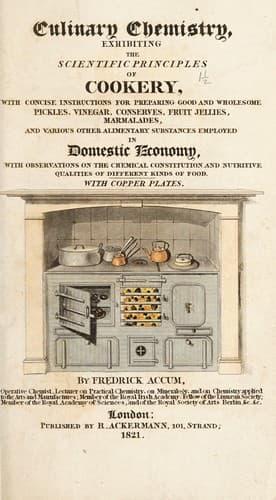
Culinary Chemistry: The Scientific Principles of Cookery, with Concise Instructions for Preparing Good and Wholesome Pickles, Vinegar, Conserves, Fruit Jellies, Marmalades, and Various Other Alimentary Substances Employed in Domestic Economy, with Observations on the Chemical Constitution and Nutritive Qualities of Different Kinds of Food.Accum, Friedrich Christian
Science
Culinary Chemistry: The Scientific Principles of Cookery, with Concise Instructions for Preparing Good and Wholesome Pickles, Vinegar, Conserves, Fruit Jellies, Marmalades, and Various Other Alimentary Substances Employed in Domestic Economy, with Observations on the Chemical Constitution and Nutritive Qualities of Different Kinds of Food.
Accum, Friedrich Christian
Cooking; Food poisoning
The coffee tree has of late years been much cultivated in America, but
the coffee which has been thence brought to Europe has been very little
esteemed. This great difference in the goodness many have attributed to
the soil in which it grows, and therefore have supposed it impossible
for the inhabitants of the British islands ever to cultivate this
commodity to any real advantage; but this is certainly a mistake, as is
affirmed by several persons of credit, who have resided abroad, who say,
that the berries which they have gathered from the trees and roasted
themselves, were as well flavoured as any of the coffee brought from
Mocha; so that the fault is in the drying, and bringing over; for if in
the drying of the berries they be laid in rooms near the sugar-works, or
near the house where rum is distilled, the berries soon imbibe the
surrounding effluvia, which will greatly alter their flavour. In like
manner the coffee brought in the same ships with rum and sugar, were the
coffee ever so good, would hereby be entirely altered.
Raw coffee materially becomes ameliorated by age. It should be kept in
bags, or vessels permeable to air, and in a dry, or rather warm place.
BEST METHOD OF MAKING COFFEE.
The general use of tea among us, has caused the inhabitants of Great
Britain to be in general far inferior than their neighbours on the
continent in the art of preparing the beverage called coffee. The
coloured water commonly drank in England under this name, is as much the
object of derision to foreigners, as their _soup maigre_ is to us; hence
a lively French writer says, “The English do not care about the quality
of coffee, if they can but get enough of it.” Coffee certainly is almost
universally made stronger on the other side of the channel than it is
here.
Count Rumford, in the eighteenth of his Essays has entered into a
minute, elaborate, and useful analysis of the powers of coffee, and the
best means of infusing it for dietetic purposes. He remarks, that among
the numerous luxuries of the table, unknown to our forefathers, coffee
may be considered as one of the most valuable. Its taste is very
agreeable, and its flavour uncommonly so; but its principal excellence
depends on its salubrity, and on its exhilarating quality. It excites
cheerfulness, without intoxication; and the pleasing flow of spirits
which it occasions, lasts many hours, and is never followed by sadness,
languor, or debility. It diffuses over the whole frame a glow of health,
and a sense of ease and well-being which is extremely delightful:
existence is felt to be a positive enjoyment, and the mental powers are
awakened, and rendered uncommonly active. After some other judicious
observations on the valuable properties of coffee, and the uncertainty
of the result in the common methods of preparing it, the Count proceeds
with his subject.
Public-domain text, read in full here on John Shaqi.
Reviews
Reviews
No reviews yet
Be the first to share your thoughts on this work.
Elsewhere in the archive
Join the Discussion
Join the discussion
Sign in to leave a comment or review.
Sign InorCreate an account