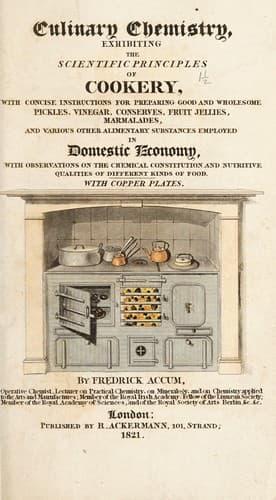
Culinary Chemistry: The Scientific Principles of Cookery, with Concise Instructions for Preparing Good and Wholesome Pickles, Vinegar, Conserves, Fruit Jellies, Marmalades, and Various Other Alimentary Substances Employed in Domestic Economy, with Observations on the Chemical Constitution and Nutritive Qualities of Different Kinds of Food.Accum, Friedrich Christian
Science
Culinary Chemistry: The Scientific Principles of Cookery, with Concise Instructions for Preparing Good and Wholesome Pickles, Vinegar, Conserves, Fruit Jellies, Marmalades, and Various Other Alimentary Substances Employed in Domestic Economy, with Observations on the Chemical Constitution and Nutritive Qualities of Different Kinds of Food.
Accum, Friedrich Christian
Cooking; Food poisoning
Different methods have been employed in making coffee; but the
preparation of the grain is nearly the same in all of them. It is first
roasted in an iron pan, or in a hollow cylinder made of sheet-iron, over
a brisk fire; and when, from the colour of the grain, and the peculiar
fragrance which it acquires in this process, it is judged to be
sufficiently roasted, it is taken from the fire, and suffered to cool.
When cold, it is ground in a mill to a coarse powder, and preserved for
use.
Great care must be taken in roasting coffee, not to roast it too much;
as soon as it has acquired a deep cinnamon colour, it should be taken
from the fire, and cooled; otherwise, much of its aromatic flavour will
be dissipated, and its taste becomes disagreeably bitter.
In order that coffee may be perfectly good, and very high flavoured, not
more than half a pound of the grain should be roasted at once; for when
the quantity is greater, it becomes impossible to regulate the heat in
such a manner as to be quite certain of a good result.
The progress of the operation, and the moment most proper to put an end
to it, may be judged and determined with great certainty, not only by
the changes which take place in the colour of the grain, but also by the
peculiar fragrance which will first begin to be diffused by it when it
is nearly roasted enough.
If the coffee in powder is not well defended from the air, it soon loses
its flavour, and becomes of little value; and the liquor is never in so
high perfection as when the coffee is made immediately after the grain
has been roasted.
Boiling-hot water extracts from coffee, which has been properly roasted
and ground, an aromatic substance of an exquisite flavour, together with
a considerable quantity of astringent matter, of a bitter but very
agreeable taste; but this aromatic substance, which is supposed to be an
oil, is extremely volatile, and is so feebly united to the water that it
escapes from it into the air with great facility. If a cup of the very
best coffee, prepared in the highest perfection, and boiling hot, be
placed on a table, in the middle of a large room, and suffered to cool,
it will in cooling fill the room with its fragrance; but the coffee,
after having become cold, will be found to have lost a great deal of
its flavour. If it be again heated, its taste and flavour will be still
further impaired; and after it has been heated and cooled two or three
times, it will be found to be quite vapid and disgusting. The fragrance
diffused through the air is a sure indication that the coffee has lost
some of its volatile parts; and as that liquor is found to have lost its
peculiar flavour, and also its exhilarating quality, there can be no
doubt but that both these depend on the preservation of those volatile
particles which escape into the air with such facility.
Public-domain text, read in full here on John Shaqi.
Reviews
Reviews
No reviews yet
Be the first to share your thoughts on this work.
Elsewhere in the archive
Join the Discussion
Join the discussion
Sign in to leave a comment or review.
Sign InorCreate an account