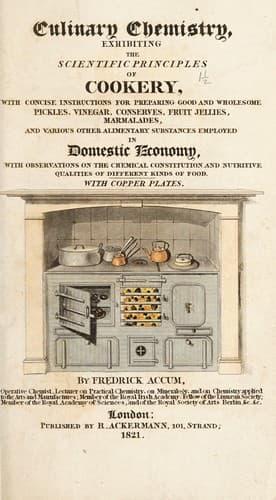
Culinary Chemistry: The Scientific Principles of Cookery, with Concise Instructions for Preparing Good and Wholesome Pickles, Vinegar, Conserves, Fruit Jellies, Marmalades, and Various Other Alimentary Substances Employed in Domestic Economy, with Observations on the Chemical Constitution and Nutritive Qualities of Different Kinds of Food.Accum, Friedrich Christian
Science
Culinary Chemistry: The Scientific Principles of Cookery, with Concise Instructions for Preparing Good and Wholesome Pickles, Vinegar, Conserves, Fruit Jellies, Marmalades, and Various Other Alimentary Substances Employed in Domestic Economy, with Observations on the Chemical Constitution and Nutritive Qualities of Different Kinds of Food.
Accum, Friedrich Christian
Cooking; Food poisoning
In order that coffee may retain all those aromatic particles which give
to that beverage its excellent qualities, nothing more is necessary than
to prevent all internal motions among the particles of that liquid; by
preventing its being exposed to any change of temperature, either
during the time employed in preparing it or afterwards, till it is
served up.
This may be done by pouring boiling water on the coffee in powder; and
as all kinds of agitation is very detrimental to coffee, not only when
made, but also while it is making, it is evident that the method
formerly practised, that of putting the ground coffee into a coffee-pot
with water, and boiling them together, must be very defective, and must
occasion a very great loss. But that is not all, for the coffee which is
prepared in that manner can never be good, whatever may be the quantity
of ground coffee that is employed. The liquor may no doubt be very
bitter, and it commonly is so; and it may possibly contain something
that may irritate the nerves,--but the exquisite flavour and
exhilarating qualities of good coffee will be wanting.
Coffee may easily be too bitter, but it is impossible that it should
ever be too fragrant. The very smell of it is reviving, and has often
been found to be useful to sick persons, and especially to those who are
afflicted with violent head-aches. In short, every thing proves that the
volatile aromatic matter, whatever it may be, that gives flavour to
coffee, is what is most valuable in it, and should be preserved with the
greatest care, and that in estimating the strength or richness of that
beverage, its fragrance should be much more attended to than either its
bitterness or its astringency.
One pound avoirdupois, of good Mocha coffee, which, when properly
roasted and ground, weighs only thirteen ounces, serves for making
fifty-six full cups of very excellent coffee.
The quantity of ground coffee for one full cup, should not be less than
108 grains troy, which is rather less than a quarter of an ounce. This
coffee, when made, fills a coffee-cup of the common size quite full.
In making coffee, several circumstances must be carefully attended to:
in the first place, the coffee must be ground fine, otherwise the hot
water will not have time to penetrate to the centres of the particles;
it will merely soften them at their surfaces, and passing rapidly
between them, will carry away but a small part of those aromatic and
astringent substances on which the goodness of the liquor entirely
depends. In this case the grounds of the coffee are more valuable than
the insipid wash which has been hurried through them, and afterwards
served up under the name of coffee.
Public-domain text, read in full here on John Shaqi.
Reviews
Reviews
No reviews yet
Be the first to share your thoughts on this work.
Elsewhere in the archive
Join the Discussion
Join the discussion
Sign in to leave a comment or review.
Sign InorCreate an account