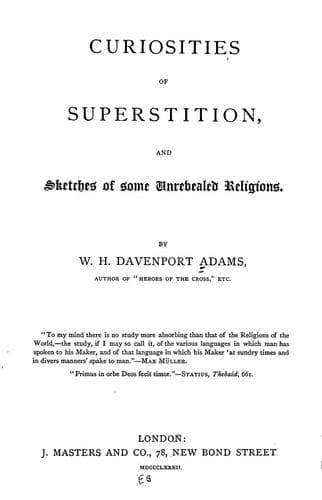
Curiosities of Superstition, and Sketches of Some Unrevealed ReligionsAdams, W. H. Davenport (William Henry Davenport)
Religion
Curiosities of Superstition, and Sketches of Some Unrevealed Religions
Adams, W. H. Davenport (William Henry Davenport)
Folklore; Religions; Superstition
Tradition asserts that his father was a descendant of the imperial family
of Hoang-ty, of the dynasty of Chang (2,000 B.C.), and the chief minister
of his native kingdom. At an early age, as is common with most who are
destined to rise to greatness, Confucius gave indisputable proof of no
ordinary mental capacity, and these budding powers were carefully
developed by the training and tuition of the ablest masters. He was still
young when he made himself acquainted with the literature of the period,
and especially with the canonical and classical books attributed to the
ancient legislators Yam Chun, and others. His amiability of temper is
warmly commended, and no shadow of reproach rests upon his moral
character; except in so far as he exposed himself to censure by divorcing
his wife, after she had borne him a son, in order, it is said, “that he
might devote himself the more absolutely to his studies.” It is some
excuse for him that, at this time, he was only twenty. In the same year he
was appointed “superintendent of cattle,”--not exactly the ideal office
for a philosophical student. However his assiduity and fidelity soon
secured the approbation of his superiors; he was promoted to a more
influential position; and there seemed every probability of his attaining
to the highest rank, when a sudden revolution in the state for a time
obscured his prospects.
The next eight years of his life he spent in travel, assuming the role of
a religious reformer, and everywhere gathering round him a crowd of ardent
disciples, whom he instructed in the rules and principles of his ethical
system. It is said that they numbered as many as 3,000, of whom
seventy-two were specially distinguished by their devotion to their
master and their rigid observance of his tenets. Returning to Loo, when he
was about forty-three years old, he was again called to the service of the
state, and from grade to grade rose to the post of Prime Minister, or
“governor of the people.” Invested with plenary power, he proceeded, with
the ardour of an enthusiast, to realise his ideas, and rapidly brought
about a vast improvement in both the moral and physical condition of the
country. The poor were the particular objects of his care: he provided
them with plentiful supplies of cheap and good food, and released them
from the thraldom in which the nobles had held them. His energy and wisdom
extended to every department of the state; and with extraordinary
fertility of resource, he initiated measures for the extension of
commerce, the improvement of the bridges and highways, the impartial
administration of justice, and the extirpation of the robber bands which
infested the mountains. But the neighbouring sovereigns regarded with
alarm the progress of his bold reforms. No doubt they talked about
communistic and socialistic doctrines, and the advancing flood of
democracy, as timid people do in our own day. At all events they contrived
Public-domain text, read in full here on John Shaqi.
Reviews
Reviews
No reviews yet
Be the first to share your thoughts on this work.
Elsewhere in the archive
Join the Discussion
Join the discussion
Sign in to leave a comment or review.
Sign InorCreate an account