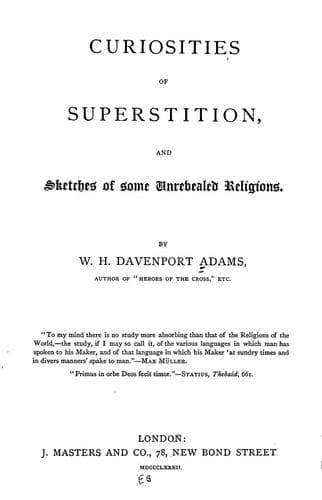
Curiosities of Superstition, and Sketches of Some Unrevealed ReligionsAdams, W. H. Davenport (William Henry Davenport)
Religion
Curiosities of Superstition, and Sketches of Some Unrevealed Religions
Adams, W. H. Davenport (William Henry Davenport)
Folklore; Religions; Superstition
to put such a pressure upon the King of Loo that he was compelled to part
with his great minister, who fled from his enemies northward, and found
refuge in the kingdom of Tsi, on the Gulf of Petchali. For twelve, or, as
some say, fourteen years he wandered from place to place, adding to the
number of his proselytes; until spent with fatigue, and bowed down with
years, he retired with a few favourite disciples to a quiet valley in his
native land, and devoted the remainder of his life to the task of revising
and improving the famous writings which for so many centuries have been
consecrated by the devout acceptance of the Chinese. He died at the age of
seventy-three, in 477 B.C.,[30] “on the eighteenth day of the second
moon,” after a seven days’ illness. Like many other great reformers,
though but indifferently treated in his lifetime, he became after death
the object of universal admiration, and to this day the Chinese pay homage
to the memory of the “Great Master,” the “Chief Doctor,” the “Wise King of
Literature,” the “Saint,” the “Instructor of Emperors and Kings.” His
descendants have been loaded with honours and privileges, and now
constitute the only hereditary nobility in the Chinese empire. Like the
princes of the blood, they are exempt from taxation. And in every city of
the first, second, and third rank, stands at least one temple dedicated to
Confucius, where the emperor himself and the mandarins are bound to
worship, with offerings of wine, fruit, and flowers,--with burning of
fragrant gums, frankincense, and tapers of sandal wood,--and with singing
of appropriate hymns. The eighteenth day of the second moon is kept sacred
by the Chinese as the anniversary of his death.
* * * * *
We have already said that the system of Confucius was ethical rather than
religious. It is absolutely free from any theological strain, and, indeed,
makes no mention of a Creator. “How should I know God,” he would say,
“when as yet I know not man?” “His system was essentially conservative; he
aimed at the correction of new vices which had crept into the body politic
by endeavouring to restore the old customs of the country; and hence the
high favour in which his system has ever been held by the rulers and
magnates of the empire. It inculcated the most perfect subordination, the
most servile obedience, and the most scrupulous adherence to ancient
usage; every social, civil, and political duty is set forth in it with the
greatest precision; but inasmuch as all the parts of the great machine of
empire are not absolutely deprived of volition, a rebellious cog-wheel or
insignificant pinion will sometimes disarrange and impede the entire
machinery.”
Public-domain text, read in full here on John Shaqi.
Reviews
Reviews
No reviews yet
Be the first to share your thoughts on this work.
Elsewhere in the archive
Join the Discussion
Join the discussion
Sign in to leave a comment or review.
Sign InorCreate an account