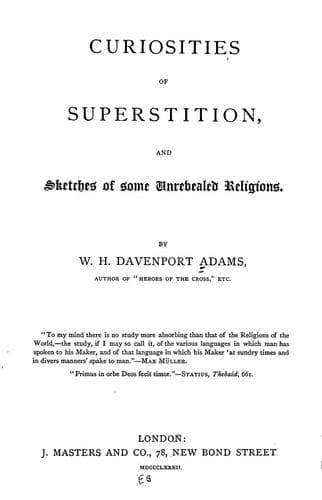
Curiosities of Superstition, and Sketches of Some Unrevealed ReligionsAdams, W. H. Davenport (William Henry Davenport)
Religion
Curiosities of Superstition, and Sketches of Some Unrevealed Religions
Adams, W. H. Davenport (William Henry Davenport)
Folklore; Religions; Superstition
Confucius held that the universe had been generated by the union of two
material principles,--a heavenly and an earthly, Yang and Ya. He
represents man as having fallen by his own act from his original purity
and happiness, and asserts that by his own act he can recover that
condition. For this purpose he must lead a life of obedience to the law,
and he must not do unto others that which he would not have others do unto
him. He made the supremacy of parental authority the basis of his
political teaching, and strongly advocated that the son’s submission to
the father must be as complete as that of the servant to the master, of
the master to the magistrate, of the magistrate to the crown, and of the
crown to the law. Of course this implied that the reciprocal obligations
must be observed. This rigid application of the family ideal to the
administration of the government, and the consequent creation of a pure
despotism, has been the cause of all that is most perplexing to Europeans
in the Chinese civilisation, and explains why it has never advanced beyond
the standard or mark to which it had attained in the era of Confucius.
The Confucian doctrines are set forth in _Gze-Chou_, “The Four Books,” and
_King_, “The Five Canonical Works,” of which the following particulars may
interest the reader.
_The Ta-heo, or “Great Study.”_
The _Ta-heo_, or “School of Adults,” has been translated by Dr. Marshman,
in the “Clavis Sinica.” It is a treatise, in two chapters, on politics and
morals, rising gradually from the government of oneself to the government
of a family, thence to the government of a province, and finally to the
control of the affairs of an empire. Its leading principle is
self-improvement, self-culture. In one of the sections an eulogium is
bestowed upon the beauty of virtue as a means of self-enjoyment. And the
book closes with a fine exhortation to be just, and truthful, and honest,
to those whom fortune places at the head of the state.
_The Chung-Yung, or “The Invariable in the Mean,”_
Also translated as “the Safe Middle Course,” and “the Infallible Medium,”
describes the golden mean, the due medium by which a man should regulate
his conduct. He is not to be lifted up by prosperity, nor cast down by
adversity. Through thirty-three sections, in language sometimes clear and
strenuous, sometimes obscure, the subject is pursued, and the whole duty
of man inculcated. Here is a passage describing a kingly man which may be
compared with one in Seneca:--
Public-domain text, read in full here on John Shaqi.
Reviews
Reviews
No reviews yet
Be the first to share your thoughts on this work.
Elsewhere in the archive
Join the Discussion
Join the discussion
Sign in to leave a comment or review.
Sign InorCreate an account