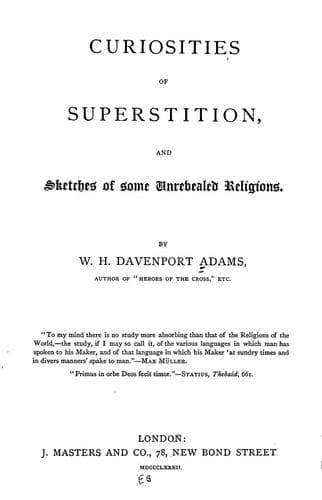
Curiosities of Superstition, and Sketches of Some Unrevealed ReligionsAdams, W. H. Davenport (William Henry Davenport)
Religion
Curiosities of Superstition, and Sketches of Some Unrevealed Religions
Adams, W. H. Davenport (William Henry Davenport)
Folklore; Religions; Superstition
“It is only the man supremely holy, who, by the faculty of knowing
thoroughly, and comprehending perfectly the primitive laws of living
beings, is worthy of possessing supreme authority, and governing men; who
by possessing a soul, grand, firm, constant, and imperturbable, is capable
of making justice and equity reign; who by his faculty of being always
honest, simple, upright, grave, and just, is able to attract respect and
veneration; who by his faculty of being clothed with the ornaments of the
mind, and the talents procured by assiduous study, and by the
enlightenment that springs from an exact investigation of the most hidden
things, and the most subtle principles, can with accuracy discern the true
from the false, and the good from the evil.”
_The Lun-Yu, or “Philosophical Conversation.”_
This is the Chinese _Phædo_, and contains a record of the conversations
held between Confucius and his disciples, but the author lacked the
eloquence and imagination of Plato. It is interesting however from its
anecdotes of the Great Teacher. In introducing his guests, it seems that
he kept his arms extended, like the wings of a bird; that he never ate
meat which had not been cut in a straight line; that he never used his
fingers to point to anything; and that he would not occupy the mat spread
for him as a seat unless it was regularly placed.
_The Meng-tze, or “Mencius,”_
Is a Commentary upon Confucius, written about a century after his death by
his disciple Meng-tze. The subjects treated in it are of various nature.
In one part the virtues of individual life and of domestic relations are
discussed; in another, the order of affairs. Here are investigated the
duties of superiors, from the sovereign to the lowest magistrate, for the
attainment of good government. There are expounded the labours of
students, peasants, traders, artisans, while, in the course of the work,
the laws of the physical world, of the heavens and the earth, the
mountains and rivers, of birds, fishes, quadrupeds, insects, plants, and
trees, are occasionally described. The great number of affairs which
Mencius managed, in the course of his life, in his intercourse with men,
his occasional conversations with people of rank, his instructions to his
pupils, his expositions of books, ancient and modern,--all these details
are incorporated in this publication. It is a collection of historical
facts, and of the words of ancient ages, put together for the instruction
of mankind.
Mencius died when he was eighty-four years of age; his memory is revered
by the Chinese next to that of Confucius, and his descendants are treated
with a distinction inferior only to that which is accorded to those of
Confucius.
_King; or, The Five Canonical Works._
These, which were either written or compiled by Confucius, are the most
venerable existing monuments of Chinese literature, and embody the
fundamental principles of the earliest creeds and customs of China.
Public-domain text, read in full here on John Shaqi.
Reviews
Reviews
No reviews yet
Be the first to share your thoughts on this work.
Elsewhere in the archive
Join the Discussion
Join the discussion
Sign in to leave a comment or review.
Sign InorCreate an account