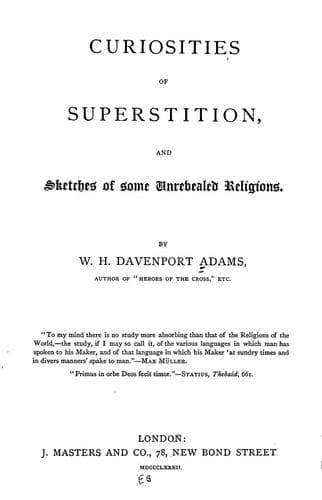
Curiosities of Superstition, and Sketches of Some Unrevealed ReligionsAdams, W. H. Davenport (William Henry Davenport)
Religion
Curiosities of Superstition, and Sketches of Some Unrevealed Religions
Adams, W. H. Davenport (William Henry Davenport)
Folklore; Religions; Superstition
The first is the _Y-King_, or “Sacred Book of Changes,” which may be
termed a Chinese Cyclopædia, and contains a great variety of subjects,
morals, physics, and metaphysics. It is founded on the combinations of
sixty-four lines,--some entire, and some broken,--and called _Koua_; the
discovery of which has been attributed to Fo-hi, the traditional founder
of Chinese civilisation. He found them, it is said, on the shell of a
tortoise, and asserted that they were capable of explaining all things. It
does not seem easy, however, to explain _them_, and the commentaries upon
them are more numerous than even the commentaries upon Shakespeare. The
Imperial Library at Peking contains no fewer than 1450.
Second in order comes the _Shu-King_, or “Book of History,” which, despite
its imperfect and fragmentary condition, is full of interest. It contains
a concise narrative of Early Chinese history, down to the eighth century
before our era; including the speeches addressed by several emperors to
their high officers, and numerous valuable documents of great antiquity.
Reference is made in its pages to a great deluge, which some suppose to be
the Flood recorded in the book of Genesis, but others, with more
probability, identify with one of the early and extensive inundations of
the Hoang-Ho.
The third is the _Shi-King_, or “Book of Sacred Songs,” a collection of
311 poems, ancient, national, and official, the best of which every
well-educated Chinaman commits to memory. They range from the eighteenth
to the third century before our era, and are divided into four parts:
first, the Ku-fung, or songs of “the manners of different states;” second
and third, songs for state occasions; and fourth, Soong, a collection of
eulogies on the various emperors of the Chow dynasty. This book is
described as replete with very interesting and probably authentic
information on the ancient manners of China, and is frequently quoted by
both Confucius and Mencius, and by them recommended to the study of their
disciples.
Fourth comes the _Li-King_, or “Book of Rites and Ceremonies,” in which we
find a mass of fragments dating from the time of Confucius downwards, and
throwing a vivid light on the permanent characteristics of the Chinese
civilisation, and on the causes which made it what it is in all its iron
immutability. The ceremonial usages of China, as prescribed in this
ritual, number about 3000; and one of the six tribunals, the Ly-pou, is
specially charged with their custody and interpretation.
Fifth and last is the _Chun-tsien_, or _Tchuntsiou_, or “Book of Spring
and Autumn,” so called from the seasons in which it was respectively begun
and ended by Confucius. Here the Great Teacher has simply written down the
earlier history of his native land of Loo; with the view of recalling the
princes of his age to a conservative spirit of reverence for the customs
of the past by indicating the misfortunes that took place after they fell
into neglect.
Public-domain text, read in full here on John Shaqi.
Reviews
Reviews
No reviews yet
Be the first to share your thoughts on this work.
Elsewhere in the archive
Join the Discussion
Join the discussion
Sign in to leave a comment or review.
Sign InorCreate an account