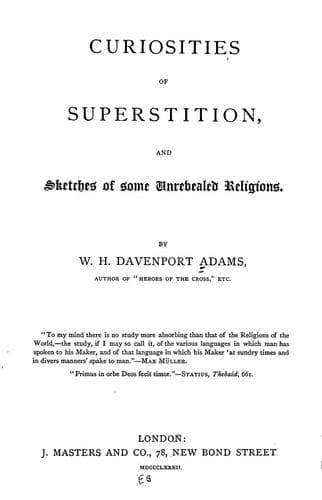
Curiosities of Superstition, and Sketches of Some Unrevealed ReligionsAdams, W. H. Davenport (William Henry Davenport)
Religion
Curiosities of Superstition, and Sketches of Some Unrevealed Religions
Adams, W. H. Davenport (William Henry Davenport)
Folklore; Religions; Superstition
* * * * *
Strictly speaking, Confucianism has no priests, no distinct sacerdotal
order; the emperor himself is the patriarch or head, and every magistrate,
within the sphere of his jurisdiction is a religious official or
hierophant. “Generally, all literary persons, and those who propose to
become such, in attaching themselves to it do not necessarily renounce
practices borrowed from other religions. But, in fact, faith does not seem
to have anything to do with the matter; and habit alone induces them to
conform to ceremonies which they themselves turn into ridicule--such as
divinations, horoscopes, and calculating lucky and unlucky days, all of
which superstitions are in great vogue throughout the empire.”
China possesses an enormous number of pagodas, or idol-temples; Peking
boasts of 10,000; every village has several, and they are distributed all
along the roads and all over the fields. Some are remarkable for their
splendour; but the majority do not differ in appearance, or very slightly,
from other buildings. Often they are nothing more than small chapels, in
which are niches containing idols and vases filled with burning perfumes,
or the ashes of gilt paper on which prayers have been printed, these
papers having been burnt, as a religious rite, by devotees. The
worshippers, if such they may be called, display the utmost indifference
of behaviour in these temples: they enter them to enjoy a rest or a sleep;
or they walk about with their hats on, whistling, smoking, laughing,
chattering. Round the sides are seated the vendors of the aforesaid gilt
paper prayers and pastiles; ever and anon they demand attention to their
wares by striking a gong; while the people incessantly burn paper models
of clothing, shoes, money, junks, and the like, to assist their deceased
friends on their long journey. For though the Chinese have no distinct
recognition of a future state, the worship of the dead is a prominent
element of their religion. Noble and peasant alike bring offerings, or
send them by proxy, and kneel before the shades of their ancestors: this
duty at least is always remembered, whatever other may be forgotten.
The following may be given as an example of the prayers used upon such
occasions:--
“I, Lea Kwang, second son of the third generation, presume to come before
the grave of my ancestors. Revolving years have brought again the season
of Spring; I sweep your tomb with reverence, and, prostrate, beg you to be
spiritually present, and grant that your posterity may be illustrious. At
this season I desire to recompense the root of my existence, and
reverently, therefore, before your holy spirit present the five-fold
offering of pork, fowl, duck, goose, and fish; with five fruits and the
drink _samshu_;[31] entreating that you will condescend to inspect them.
This announcement is presented on high.”
Public-domain text, read in full here on John Shaqi.
Reviews
Reviews
No reviews yet
Be the first to share your thoughts on this work.
Elsewhere in the archive
Join the Discussion
Join the discussion
Sign in to leave a comment or review.
Sign InorCreate an account