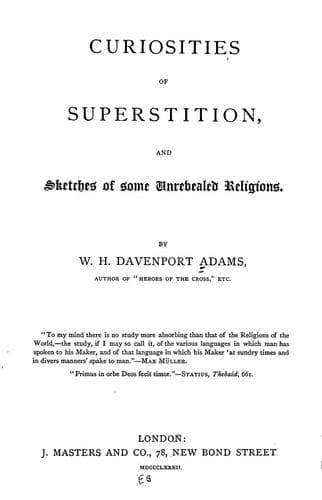
Curiosities of Superstition, and Sketches of Some Unrevealed ReligionsAdams, W. H. Davenport (William Henry Davenport)
Religion
Curiosities of Superstition, and Sketches of Some Unrevealed Religions
Adams, W. H. Davenport (William Henry Davenport)
Folklore; Religions; Superstition
Such offerings as are not accepted by the priests are generally taken home
again to furnish full the worshipper’s own table.
* * * * *
The Ritual State Worship, which concerns the Emperor and his court, but
affects not the great body of the people, we must glance at very briefly.
It may be defined as the ceremonial of a philosophical pantheism,
unconnected with any theological doctrine. Three classes of natural
objects are distinguished, to which the “Great,” the “Medium,” and the
“Lesser” Sacrifices are offered. The first class, the _Ta-sze_, includes
the Heaven and the Earth, and along with and equal to these, the great
Temple of Imperial Ancestors. Among the _Chung-sze_, or “Medium
Sacrifices,” are the Genii, the Great Light and the Evening Light (that
is, the Sun and the Moon), the Gods of Land and Grain, the God of Letters,
and the Inventors of Agriculture, Manufactures, and the Useful Arts. To
the “Lesser Sacrifices,” or _Scaou-sze_, belong the Founder of the Art of
Healing, as well as the spirits of statesmen, scholars, and persons of
eminent virtue. They are offered also to various natural phenomena, such
as the clouds, the rain, the wind, the thunder. The God of War, and Lung
Wang, the dragon-king, who represents the rivers and streams, have their
worshippers; nor is Tien-How, the Queen of Heaven, forgotten. There are,
besides, a host of household deities, like the Lares and Penates of the
ancients, who are propitiated by domestic sacrifices at the new year, when
they are supposed to pay a brief visit to the Other World, and report, as
it were, the doings and misdoings of the families over which they preside.
The chief sacrificial seasons are these: the winter solstice for all
offered to heaven, the summer season for all offered to earth. The others
have their appointed dates. Then, in the course of the year, numerous
festivals of a more or less religious character are held. First among them
is the Imperial Ploughing of the Sacred Field, which takes place towards
the end of March. The Emperor, attended by some of the princes of the
blood and his chief ministers, then proceeds to a field on one side of the
central street in Peking, where fitting preparations have, of course, been
made. After certain sacrifices, consisting chiefly of grain preserved from
the produce of the same field, the Emperor takes the plough, and drives a
few furrows. His example is followed by the princes and ministers in
succession: a red tablet indicating the space allotted to each
distinguished amateur. The “five sorts of grain” are then sown; and when
the Emperor has seen the work completed by the attendant husbandmen, the
field is committed to the charge of an officer whose business it is to
collect and store the produce with a view to future sacrifices to the Gods
of the Harvest.
* * * * *
Public-domain text, read in full here on John Shaqi.
Reviews
Reviews
No reviews yet
Be the first to share your thoughts on this work.
Elsewhere in the archive
Join the Discussion
Join the discussion
Sign in to leave a comment or review.
Sign InorCreate an account