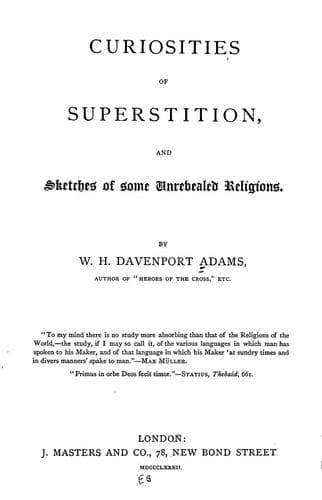
Curiosities of Superstition, and Sketches of Some Unrevealed ReligionsAdams, W. H. Davenport (William Henry Davenport)
Religion
Curiosities of Superstition, and Sketches of Some Unrevealed Religions
Adams, W. H. Davenport (William Henry Davenport)
Folklore; Religions; Superstition
Of the _Shae-tung_, or Feast of Lanterns, every traveller has spoken.
There are also the _Too-te-tan_, or birthdays of the familiar gods of the
city; the _Tsing-ming-tsee_, or Feast of Tombs; the festivals of all and
sundry deities; and the birthdays of the living Emperor and Empress, as
well as the anniversaries of the deaths of their predecessors, which,
however, are observed only by the mandarins. So numerous are the festivals
that were they celebrated everywhere by everybody there would be neither
“time” nor “hands” for the works of agriculture or commerce, trade,
science, or the arts.
* * * * *
We pass on to a brief account of
TAOUISM.
The founder of Taouism, the doctrine of Tao, or Reason, was a celebrated
philosopher named Lao-tsze, who was born in the third year of the Emperor
Ting-wang, of the Chow dynasty (B.C. 604) in the state of Tseu, now known
as Hoo-pih and Hoo-nan. He preceded Confucius by half a century. His
family name was _Le_, or Plum, and his youthful name, _Urh_, or Ear, in
allusion to the exceptional size of his “auricular appendages.” The events
of his career are so obscured in an atmosphere of legend and fable,
created by admiring disciples, that it is difficult to get at any
authentic particulars; but he seems to have been an assiduous student, and
the historian or chronologist of a king of the Chow dynasty. Visiting,
about B.C. 600, the western parts of China, he gained there a knowledge of
the system of Fo, or Buddha, and soon afterwards began to develope his own
religious teaching. So great was his fame that Confucius went to see him;
but the interview was hardly of the character that might have been
expected when two religious philosophers met. Lao-tsze reproached the
younger sage with pride and ostentation and vanity, affirming that
philosophers loved retirement and seclusion, and made no boast of virtue
and knowledge. It speaks well for the good nature of Confucius that he
replied to this tirade by highly commending Lao-tsze to his followers, and
describing him as a dragon soaring to the clouds of Heaven, unsurpassed
and unsurpassable.
Lao-tsze inquired of Confucius if he had discovered the _Taou_, the “path”
or “reason” by which Heaven acts, and was informed that the philosopher
had searched for it unsuccessfully. Lao-tsze replied that the wealthy
dismissed their friends with presents, and sages theirs with good counsel;
and that for himself, he humbly claimed to be thought a sage--an indirect
way of advising Confucius to continue his quest of the _Taou_. Retiring to
Han-kwan, he wrote there his _Taou-tih-king_, or Book of Reason and
Virtue. He died, or as his followers say, ascended to Heaven on a black
buffalo, in the twenty-first year of the reign of King-wang of the Chow or
Cheu dynasty, or B.C. 523, having attained the age of 119 years.[32]
Public-domain text, read in full here on John Shaqi.
Reviews
Reviews
No reviews yet
Be the first to share your thoughts on this work.
Elsewhere in the archive
Join the Discussion
Join the discussion
Sign in to leave a comment or review.
Sign InorCreate an account