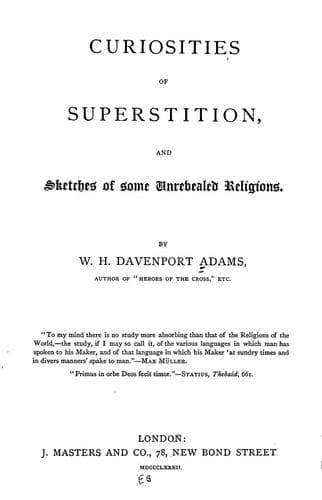
Curiosities of Superstition, and Sketches of Some Unrevealed ReligionsAdams, W. H. Davenport (William Henry Davenport)
Religion
Curiosities of Superstition, and Sketches of Some Unrevealed Religions
Adams, W. H. Davenport (William Henry Davenport)
Folklore; Religions; Superstition
The contrast between the system of Lao-tsze and that of Confucius may be
indicated in a word: the former was _speculative_, the latter _practical_,
and it is no wonder, therefore that the latter, addressing itself to man’s
actual necessities and daily duties, prevailed over the former. But, in an
abstract sense, Lao’s, as originally defined by himself, was the purer and
more elevated; for it aimed at securing the immortality of man through the
contemplation of GOD, the subjugation of the passions, and the absolute
tranquillity of the soul. He taught that Silence and the Void generated
the Taou, the “Logos” or reason by which movement was produced; and that
all beings containing in themselves the duality of male and female sprang
from them.
Man, he said, was composed of two principles, the material and the
spiritual: from the latter he emanated, and to it he ought to return, by
throwing off the fetters and snares of the world, crushing out the
material passions, the desires of the soul, and the pleasures of the body,
and abandoning riches, honours, and the ties of life.
Before Lao-tsze’s time, the Chinese seem to have worshipped the
_Shang-te_, or Supreme Ruler, and the _Tien_, or Heaven: but Lao-tsze
preached in their place the _Taou_, or “reason” of the Kosmos. Of a
Supreme Creative and Eternal Power he had no conception. There was as
little theology in his system as in that of Confucius; but its morality
was not less admirable; it insisted on the practice of those virtues which
form the moral code of all the higher religions,--charity, benevolence,
chastity, and the free-will, moral agency, and responsibility of man. But
there was an obscurity about Lao-tsze’s teaching, which enabled his
followers successfully to pervert it, and it gradually assumed a form
which the Teacher himself would undoubtedly have been the first to
repudiate. The Taossi, as they were called, professed to have discovered
the drink of immortality, and practised divination, alchemy, the
invocation of spirits, and other superstitious rites. These follies were
gravely ridiculed by the Joo-Keaou, or sect of Confucius, and gradually
were abandoned by all but the most illiterate.
Public-domain text, read in full here on John Shaqi.
Reviews
Reviews
No reviews yet
Be the first to share your thoughts on this work.
Elsewhere in the archive
Join the Discussion
Join the discussion
Sign in to leave a comment or review.
Sign InorCreate an account