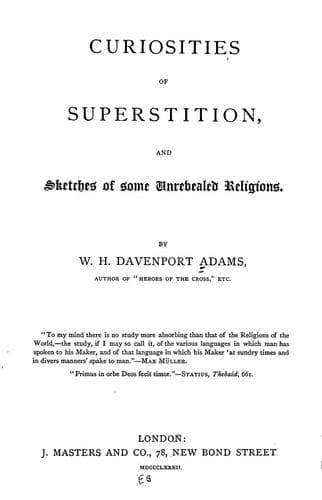
Curiosities of Superstition, and Sketches of Some Unrevealed ReligionsAdams, W. H. Davenport (William Henry Davenport)
Religion
Curiosities of Superstition, and Sketches of Some Unrevealed Religions
Adams, W. H. Davenport (William Henry Davenport)
Folklore; Religions; Superstition
Among the host of deities worshipped by this sect we may instance the
_San-tsing_, or “Three Pure Ones,” the three-fold ruler of the assembled
gods in heaven, the sun, the moon, and the stars, who delivers his name
and benevolent commands to be promulgated amongst mankind, that all who
see and recite that name may be delivered from all evil, and obtain
infinite happiness. “It is impossible to doubt,” says a writer, “that we
see here traces of a Divine revelation, corrupted though it has now
become. China has her Trinity in Taouism as well as in Buddhism; as other
Pagan nations have had theirs in the Orphic mythology, where there were
‘counsel, and light, and life;’ in the Platonic theology, which had its
‘good, and mind, and the soul of the world,’ as in the Egyptian mysteries
there were ‘On, and Isis, and Neith;’ and in that of Fo, ‘Brahma, Vishnu,
and Seeva.’”
The Taossi, Tien-sze, or “Celestial Doctors,”--the priests of
Taouism,--are outwardly distinguished amongst the Chinese by the manner in
which they dress their hair. They shave the sides of the head, and coil
the remaining hair in a tuft on the crown. Moreover, they wear
slate-coloured robes. There are two orders; one, the keepers of the
temples, vowed to celibacy; the others, who are free to marry, live in
their own houses, or wander about the country selling charms and medical
nostrums. In the feast of one of their deities, the “High Emperor of all
the Sombre Heavens,” they assemble before his temple, and having kindled a
huge fire, about fifteen or twenty feet in diameter, go over it barefoot,
carrying the gods in their arms. “They firmly assert,” says Williams,
“that if they possess a sincere mind they will not be injured by the fire;
but both priests and people get miserably burnt on these occasions.”
Escayrac de Lauture says that they leap, dance, and whirl round the fire,
striking at the devils with a straight Roman-like sword, and sometimes
wounding themselves as the priests of Baal and Moloch were wont to do.
* * * * *
Some interesting particulars of the Buddhist temples of China are supplied
by Mr. Fortune. He speaks of the temple of Tien-tung as a congeries of
temples, a collection of spacious structures, which occupy the site of
former buildings. All of these are crowded with idols, or images of the
favourite gods, such as the “Three precious Buddhas,” “the Queen of
Heaven,” represented as sitting on the celebrated lotus or nelumbium--“the
God of War,” and many other deified kings and great men of former days.
Many of these images are from thirty to forty feet in height, and have a
striking appearance as they stand arranged in the spacious lofty halls.
The priests themselves reside in a range of low buildings, erected at
right angles with the different temples and courts that divide them. Each
has a little temple under his own roof; a family altar crowded with petty
images, where he is often engaged in private devotion.
Public-domain text, read in full here on John Shaqi.
Reviews
Reviews
No reviews yet
Be the first to share your thoughts on this work.
Elsewhere in the archive
Join the Discussion
Join the discussion
Sign in to leave a comment or review.
Sign InorCreate an account