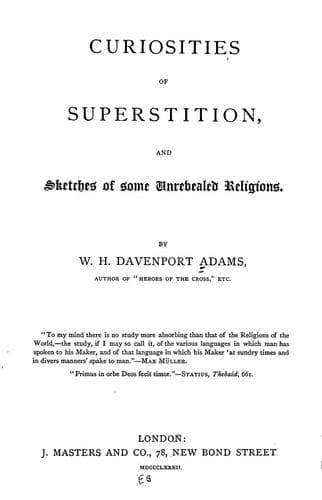
Curiosities of Superstition, and Sketches of Some Unrevealed ReligionsAdams, W. H. Davenport (William Henry Davenport)
Religion
Curiosities of Superstition, and Sketches of Some Unrevealed Religions
Adams, W. H. Davenport (William Henry Davenport)
Folklore; Religions; Superstition
“He whose power these snowy mountains, whose power the sea proclaims,
with the distant river--He whose these regions are, as it were, His two
arms:--Who is the God to whom we shall offer our sacrifice?
“He through whom the sky is bright and the earth firm--He through whom
heaven was stablished--nay, the highest heaven--He who measured out the
light in the air:--Who is the God to whom we shall offer our sacrifice?
“He to whom heaven and earth, standing firm by His will, look up,
trembling inwardly--He over whom the rising sun shines forth:--Who is the
GOD to whom we shall offer our sacrifice?
“Wherever the mighty water-clouds went, where they placed the reed and lit
the fire, thence even He, who is the only life of the bright gods:--Who is
the GOD to whom we shall offer our sacrifice?
“He, who of His might looked even over the water-clouds, the clouds which
gave strength and lit the sacrifice, He _who is God above all gods_:--Who
is the God to whom we shall offer our sacrifice?
“May He not destroy us--He the creator of the earth; or He, the righteous,
who created Heaven; He who also created the bright and mighty waters:--Who
is the God to whom we shall offer our sacrifice?”
* * * * *
The creed of a plurality of gods was one that carried in itself the seeds
of its destruction. But there was another cause of weakness in their
mortal attributes. Deriving their existence from the life of nature, they
were subject to the accidents which that life involved. Thus, the sun at
noonday might glow with splendour, but at night it was conquered by the
shadows, and in winter it seemed to yield to some stronger Power. The moon
waxed and waned, and was frequently eclipsed. As nature is subject to
change, so also must be the gods that represent its forces and aspects.
Such instability, such inherent weakness could not long satisfy the human
mind; having risen to the height of the idea of one God, it next demanded
that that God should be immutable. What rest, what contentment would it
find in the supposition of deities as changeful as the winds? Tossed about
by the currents of passion and feeling, buffeted by adverse circumstances,
the soul yearns intensely for something fixed, something absolute,
something unaffected by vicissitude, and finds it in the Divine Being, the
same to-day as yesterday, and the same to-morrow as to-day.
Public-domain text, read in full here on John Shaqi.
Reviews
Reviews
No reviews yet
Be the first to share your thoughts on this work.
Join the Discussion
Join the discussion
Sign in to leave a comment or review.
Sign InorCreate an account