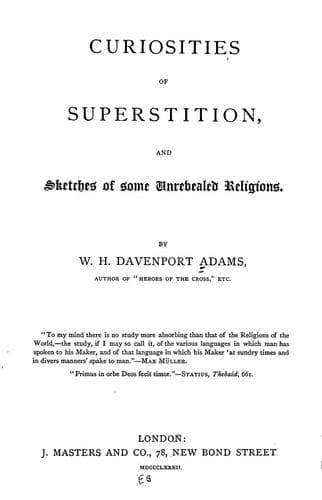
Curiosities of Superstition, and Sketches of Some Unrevealed ReligionsAdams, W. H. Davenport (William Henry Davenport)
Religion
Curiosities of Superstition, and Sketches of Some Unrevealed Religions
Adams, W. H. Davenport (William Henry Davenport)
Folklore; Religions; Superstition
“Welcome, the lord of light and lamp of day;
Welcome, fosterer of tender herbis green;
Welcome, quickener of flourished flowers’ sheen;
Welcome, support of every root and vein;
Welcome, comfort of all kind fruits and grain;
Welcome, the bird’s green beild upon the brier;
Welcome, master and ruler of the year;
Welcome, welfare of husbands at the ploughs;
Welcome, repairer of woods, trees, and boughs;
Welcome, depainter of the bloomit meads;
Welcome, the life of everything that spreads.”
And because it was all this, and more, the Hindu saw in it something
greater than a mere luminary,--a planetary body; he endowed it with Divine
attributes, he made it a god, he gave it his worship, and by an elaborate
symbolism kept it ever before him.
A necessary consequence of this deification of the sun was the
deification of the other bodies that shared with him the firmament; but as
they were inferior in splendour and utility, they naturally became
recognized as inferior gods. And when once the religious feeling of
humanity had gone thus far, its further development became only a question
of time. The homage given to the stars was soon extended to the winds and
streams and groves. A legion of gods sprang into existence, and for a
while they seemed to satisfy the needs and aspirations of humanity. But as
the thoughts of men expanded, as their intellect ripened with the ages,
and grew strong enough to doubt, and bold enough to question the
conclusions of the common faith, a revolt took place against “the
contradictions of a mythological phraseology, though it had been hallowed
by sacred customs and traditions.” Men grew tired of so complex and
cumbrous a religious system, and having observed a definite fundamental
unity of nature in spite of the diversity of its operations, they came to
believe in a similar unity of the Divine Power. The idea of a supreme
authority once entertained, men soon understood that supremacy meant
oneness; that if there were a God over all, He must be one and
indivisible. One of the earliest proclamations of this sublime truth is
found in the Rig-Veda, which says:[3]--
“That which is one the sages speak of in many ways--they call it Agni,
Yama, Malarisvan.”
And again:[4]--
“In the beginning there came the Source of golden light--He was the only
true Lord of all that is--He stablished the earth and this sky:--Who is
God to whom we shall offer our sacrifice?
“He who gives life, He who gives strength; whose blessing all the bright
gods desire; whose shadow is immortality; whose shadow is death:--Who is
the God to whom we shall offer our sacrifice?
“He who through His power is the only King of the breathing and awakening
world; He who governs all, man and beast:--Who is the God to whom we shall
offer our sacrifice?
Public-domain text, read in full here on John Shaqi.
Reviews
Reviews
No reviews yet
Be the first to share your thoughts on this work.
Join the Discussion
Join the discussion
Sign in to leave a comment or review.
Sign InorCreate an account