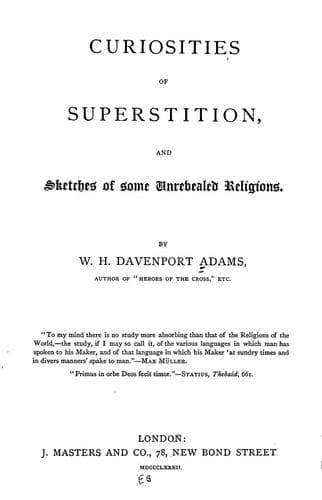
Curiosities of Superstition, and Sketches of Some Unrevealed ReligionsAdams, W. H. Davenport (William Henry Davenport)
Religion
Curiosities of Superstition, and Sketches of Some Unrevealed Religions
Adams, W. H. Davenport (William Henry Davenport)
Folklore; Religions; Superstition
Mr. Fortune, after inspecting the various temples and the belfry, which
contains a noble bronze bell of large dimensions, was conducted to the
house of the principal priest, where dinner was already spread upon the
table. The Buddhist priests are not permitted to eat animal food at any of
their meals. The dinner, therefore, consisted entirely of vegetables,
served _à la Chinoise_, in numerous small round basins, the contents of
each--soups excepted--being cut up into small square bits, to be eaten
with chopsticks. The Buddhist priests contrive to procure a quantity of
vegetables of different kinds, which, by a peculiar mode of preparation,
are rendered very savoury. “In fact,” says Mr. Fortune,[33] “so nearly do
they resemble animal food in taste and in appearance, that at first we
were deceived, imagining that the little bits we were able to get hold of
with our chopsticks were really pieces of fowl or beef. Such, however, was
not the case, as our good host was consistent on this day at least, and
had nothing but vegetable productions at his table. Several other priests
sat with us at table, and a large number of others of inferior rank with
servants, crowded around the doors and windows outside.”
During dinner, Mr. Fortune learned that about a hundred priests were
connected with the monastery, but that many were always about on missions
to various parts of the country. A considerable portion of land in the
vicinity belonged to the temple, and supplied its revenue: large sums were
raised every year from the sale of bamboos, which are here very excellent,
and of the branches of trees and brushwood, which are made up in bundles
for firewood. Many rice and tea farms also belong to the priests and are
cultivated by them. In addition to the sums thus raised, a considerable
revenue must accrue from the contributions of the devotees who frequent
the temple, as well as from the alms and donations collected by the
mendicant priests of the order, who are sent out on begging excursions at
stated periods of the year. There are, of course, all grades of priests;
some being merely the servants of the others, both domestic and
agricultural.
Public-domain text, read in full here on John Shaqi.
Reviews
Reviews
No reviews yet
Be the first to share your thoughts on this work.
Elsewhere in the archive
Join the Discussion
Join the discussion
Sign in to leave a comment or review.
Sign InorCreate an account