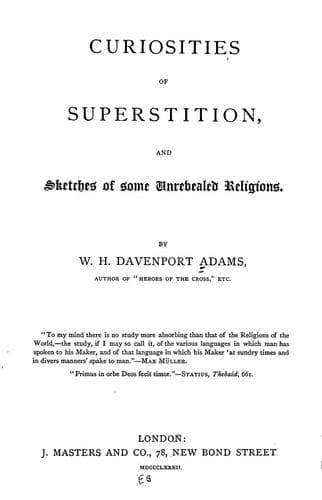
Curiosities of Superstition, and Sketches of Some Unrevealed ReligionsAdams, W. H. Davenport (William Henry Davenport)
Religion
Curiosities of Superstition, and Sketches of Some Unrevealed Religions
Adams, W. H. Davenport (William Henry Davenport)
Folklore; Religions; Superstition
Their superiority to many savage races is attested by their faithfulness
in marriage; they practise monogamy. When a young man has chosen his
future partner, his friends or relatives ask the consent of their parents,
which is never refused. The marriage day is fixed, and in the morning,
before sunrise, the maiden is despatched into the forest, where she
conceals herself or not, according to her inclinations towards her suitor.
An hour’s grace is allowed, and the young man then goes in search of her:
if he succeed in finding her, and bringing her back to her friends before
sunset, she becomes his wife; but if he fail, he is required to abandon
all further claim to the damsel. A strange custom! But there is this much
at least to be said for it, that it allows the maiden more liberty of
choice than she always enjoys in civilised society!
Whether the Ahetas (or Negritos) sprang from a mixture of Malay and Papuan
blood, or are of purely Papuan origin, our ethnologists do not seem to
have determined. But in their present development they are certainly
superior to the Papuan races.[36]
CHAPTER VIII.
_THE SAVAGE RACES OF ASIA: THE SAMOJEDES; THE MONGOLS; THE OSTIAKS; IN
TIBET._
THE SAMOJEDES.
The Samojedes are a people of Arctic Asia, where they inhabit the forests
and stony tundras of Northern Russia and Western Siberia; driving their
herds of reindeer from the banks of the Chatanga to the ice-bound shores
of the White Sea, or hunting the wild beasts in the thick forests which
extend between the Obi and the Yenisei.
Their superstition is of a very coarse and degrading character. It is true
that they recognise the existence of a Supreme Deity, named
Jilibeambaertje, or Num, who resides in the air, and, like the Greek Zeus,
sends down rain and snow, thunder and lightning; and they afford a proof
of that latent capacity for poetical feeling, which some of even the most
barbarous tribes possess, in their description of the rainbow as “the hem
of his garment.” To them, however, he seems so elevated above the things
of earth, so indifferent to the woes or joys of humanity, that they regard
it as useless to seek to propitiate him either by prayer or sacrifice; and
accordingly they appeal to the inferior gods who have, as they believe,
the control of human affairs, and can be affected by incantations, vows,
or special homage.
Public-domain text, read in full here on John Shaqi.
Reviews
Reviews
No reviews yet
Be the first to share your thoughts on this work.
Elsewhere in the archive
Join the Discussion
Join the discussion
Sign in to leave a comment or review.
Sign InorCreate an account