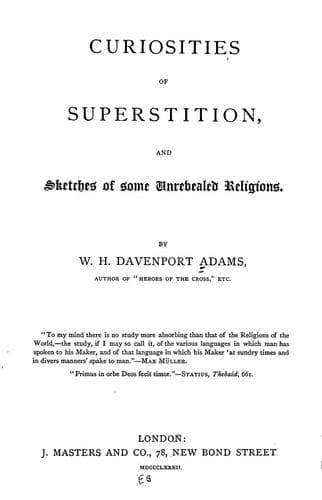
Curiosities of Superstition, and Sketches of Some Unrevealed ReligionsAdams, W. H. Davenport (William Henry Davenport)
Religion
Curiosities of Superstition, and Sketches of Some Unrevealed Religions
Adams, W. H. Davenport (William Henry Davenport)
Folklore; Religions; Superstition
A similar issue was worked out in India, but with this difference; that
the seeming triumph of reason threatened to end in the destruction of all
religious belief. At the outset no vehement contention took place. On the
basis of the old mythology arose two new formations,--the Brahmanical
philosophy and the Brahmanical ceremonial; the former opening up all
avenues of philosophical inquiry, the latter immuring religious sentiment
and sympathy within the narrowest possible barriers. Both, however,
claimed to find their origin and antiquity in the sacred book of the Veda.
It was in the sixteenth or fifteenth century before CHRIST that the
Brahmans, a branch of the white Aryans, passed into Hindustan from the
north-west, and mixed with a more numerous race of coloured and barbarous
aborigines. Among their immigrants the sacerdotal and the royal or noble
classes already occupied an authoritative and a distinct position; and
soon after their settlement in India, the lower classes, by a natural
process, sank into the markedly inferior condition of the aborigines. Thus
was established a singularly rigorous system of caste,--the priesthood
and the aristocracy combining to oppress and keep down the two inferior
orders of the Brahmans and the aborigines. Intermarriage was strictly
forbidden, and every device adopted which could be made useful in
strengthening and perpetuating the class-distinction.
This revolution in the social world assisted the revolution in the
religious; and the educated classes rapidly abandoned their nature worship
in favour of the idea of an infinite and everlasting Godhead, which soared
far above the feeblenesses and sins of humanity. To become one with this
Godhead by throwing off the personality linked with a mind that was mean
and miserable, thenceforth constituted the religious aspiration of the
Brahman. And in attaining this object he was instructed to seek the help
of the Brahmanical priesthood; nay, he was taught that without that help
he would never succeed, and for this purpose a complex and comprehensive
ceremonial was enjoined upon him. From his cradle to his grave it dogged
his footsteps. Put forward as a stay and support, it was really a clog, an
encumbrance. Not an event in his life could take place for which a formula
of praise or prayer was not invented. Thanksgiving and sacrifice were
alike minutely regulated. For the benefit of the inferior castes the old
Pantheon of gods and demons had been retained, and the priesthood allotted
to each his share of the worshipper’s offerings and oblations. Each was
represented as insisting so strongly on certain observances, and punishing
so heavily any neglect or violation of them, that the votary feared to
approach their shrine unless under the protection and guidance of their
priests. Otherwise he might unwittingly rush into all kinds of sins. They
alone knew what food might be eaten, what dress might be worn, what god
might be addressed, what sacrifice paid.
Public-domain text, read in full here on John Shaqi.
Reviews
Reviews
No reviews yet
Be the first to share your thoughts on this work.
Join the Discussion
Join the discussion
Sign in to leave a comment or review.
Sign InorCreate an account