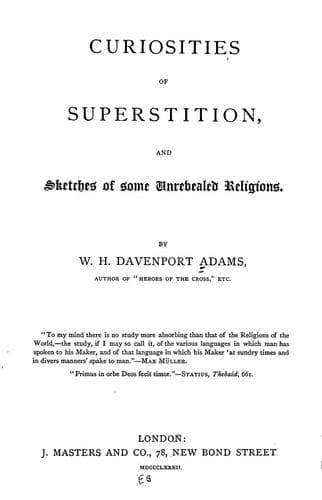
Curiosities of Superstition, and Sketches of Some Unrevealed ReligionsAdams, W. H. Davenport (William Henry Davenport)
Religion
Curiosities of Superstition, and Sketches of Some Unrevealed Religions
Adams, W. H. Davenport (William Henry Davenport)
Folklore; Religions; Superstition
An error in pronunciation, a
mistake about clarified butter, an unauthorised arrangement of raiment or
hair, might involve the unassisted worshipper in pains and penalties of
the most awful character. Never was so complete and absolute a ceremonial
system known as that by which the Hindu priesthood obtained an entire
mastery over the Hindu people. Never was any law more minute in its
provisions, or more Draconic in the severity with which it punished their
violation.
Yet, strange to say, this ceremonial did not interfere with liberty of
thought. Any amount of heresy was compatible with its observance. A man
might think as he liked so long as he complied with its various
conditions. In some of the Brahmanical schools of thought the names of the
devs or gods were never heard; in others their existence was ignored, was
virtually contradicted. Thus, one philosophical system maintained the
existence of a single Supreme Being, and asserted that everything else
which seemed to exist was but a dream and an illusion which might and
would be dispelled by a true knowledge of the One God. Another contended
for two principles,--first, a Mind, subjective and self-existent; second,
Matter endowed with qualities; and explained that the world with its cloud
and sunshine, its sorrows and joys, was the result of the subjective self,
reflected in the mirror of Matter, and that the freedom of the soul could
be secured only by diverting the gaze from the shows and phantasms of
Nature, and becoming absorbed in the knowledge of the true and absolute
self. A third system allowed the existence of atoms, and referred every
effect, including the elements and the mind, gods, men, and animals to
their fortuitous concourse. This was identical with the Lucretian system,
which in its turn was related to the Epicurean. Hence it has been said
that the history of the philosophy of India is an abridgment of the
history of philosophy. Each of these systems was traced back to the sacred
books of the Vedas, Brâhmanas and Upanishads; and those who believed in
any one of them was considered as orthodox as the most devout worshipper
of Agni,--if the latter were saved by works and faith, the former was
saved by faith and knowledge,--a distinction not unknown in the Christian
philosophy.[7]
Out of this condition of the Hindu mind arose Buddhism, springing from it
as naturally as the flower from the seed.
Public-domain text, read in full here on John Shaqi.
Reviews
Reviews
No reviews yet
Be the first to share your thoughts on this work.
Join the Discussion
Join the discussion
Sign in to leave a comment or review.
Sign InorCreate an account