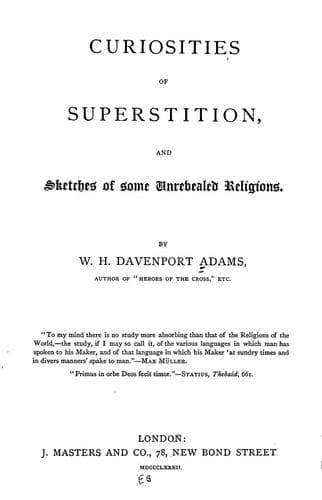
Curiosities of Superstition, and Sketches of Some Unrevealed ReligionsAdams, W. H. Davenport (William Henry Davenport)
Religion
Curiosities of Superstition, and Sketches of Some Unrevealed Religions
Adams, W. H. Davenport (William Henry Davenport)
Folklore; Religions; Superstition
According to Mr. Reade, these savages have their Naiads and Dryads; their
spirits of the mountains and the forests, the lakes and the streams, and
the high places. They have also their Typhon and their Osiris, their Good
and Evil Genius; thus recognising, in common with almost every other
race, the enduring antagonism between the Principles and Powers of Good
and Evil. The Evil Spirit, _Mbwiri_, they worship with a special homage;
his might is to be dreaded, and his anger, if possible, averted. He is the
lord of earth; and before him, as before a tyrant whose hand can grasp
their lives and fortunes, they bend in humble adoration. But as the Good
Spirit will do them no injury, they conceive it unnecessary to address to
it any regular or formal prayer. “The word by which they express this
Supreme Being answers exactly to our word of God. Like the Jehovah of the
Hebrews, like that word in masonry which is only known to masters, and
never pronounced but in a whisper and in full lodge, this word they seldom
dare to speak; and they display uneasiness if it is uttered before them.
Twice only,” says Mr. Reade, “I remember having heard it. Once when we
were in a dangerous storm, the men threw their clenched hands upwards and
cried it twice. And again, when I was at Ngambi, taking down words from an
Ashira slave, I asked him what was the word for God in the language of his
country. He raised his eyes, and pointing to heaven, said in a soft voice,
_Njambi_.”
Epileptic diseases, in almost all uncivilised countries, are assumed to be
the result of demoniac possession. In Africa the sufferer is supposed to
be possessed by Mbwiri, and he can be relieved only by the intervention of
the medicine-man or fetich. In the middle of the street a hut is built for
his accommodation, and there he resides until cured, or maddened, along
with the priest and his disciples. There for ten days or a fortnight a
continuous revel is held; much eating and drinking at the expense of the
patient’s relatives, and unending dances to the sound of flute and drum.
For obvious reasons the fetich gives out that Mbwiri regards good living
with aversion. The patient dances, usually shamming madness, until the
epileptic attack comes on, with all its dreadful concomitants--the
frenzied stare, the convulsed limbs, the gnashing teeth, and the
foam-flecked lips. The man’s actions at this period are not ascribed to
himself, but to the demon which has control of him. When a cure has been
effected, real or pretended, the patient builds a little fetich-house,
avoids certain kinds of food, and performs certain duties. Sometimes the
process terminates in the patient’s insanity; he has been known to run
away to the bush, hide from all human beings, and live on the roots and
berries of the forest.
Public-domain text, read in full here on John Shaqi.
Reviews
Reviews
No reviews yet
Be the first to share your thoughts on this work.
Elsewhere in the archive
Join the Discussion
Join the discussion
Sign in to leave a comment or review.
Sign InorCreate an account