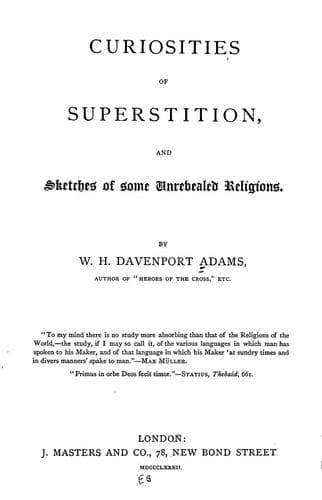
Curiosities of Superstition, and Sketches of Some Unrevealed ReligionsAdams, W. H. Davenport (William Henry Davenport)
Religion
Curiosities of Superstition, and Sketches of Some Unrevealed Religions
Adams, W. H. Davenport (William Henry Davenport)
Folklore; Religions; Superstition
“These fetich-men are priest doctors, like those of the ancient Germans.
They have a profound knowledge of herbs, and also of human nature, for
they always monopolize the real power in the state. But it is very
doubtful whether they possess any secrets save that of extracting virtue
and poison from plants. During the first trip which I made into the bush I
sent for one of these doctors. At that time I was staying among the
Shekani, who are celebrated for their fetich. He came attended by
half-a-dozen disciples. He was a tall man, dressed in white, with a girdle
of leopard’s skin, from which hung an iron bell, of the same shape as our
sheep bells. He had two chalk marks over his eyes. I took some of my own
hair, frizzled it with a burning glass, and gave it to him. He popped it
with alacrity into his little grass bag; for white man’s hair is fetich of
the first order. Then I poured out some raspberry vinegar into a glass,
drank a little of it first, country fashion, and offered it to him,
telling him that it was blood from the brains of great doctors. Upon this
he received it with great reverence, and dipping his fingers into it as if
it was snap-dragon, sprinkled with it his forehead, both feet between the
two first toes, and the ground behind his back. He then handed his glass
to a disciple, who emptied it, and smacked his lips afterwards in a very
secular manner. I then desired to see a little of his fetich. He drew on
the ground with red chalk some hieroglyphics, among which I distinguished
the circle, the cross, and the crescent. He said that if I would give him
a fine ‘dush,’ he would tell me all about it. But as he would not take
anything in reason, and as I knew that he would tell me nothing of very
great importance in public, negotiations were suspended.”
The fetich-man seldom finds a native disposed to question his claim to
supernatural powers. He is not only a doctor and a priest,--two capacities
in which his influence is necessarily very powerful; he is also a
witch-finder, and this is an office which invests him with a truly
formidable authority. When a man of worth dies, his death is invariably
ascribed to witchcraft, and the aid of the fetich-man is invoked to
discover the witch.
Public-domain text, read in full here on John Shaqi.
Reviews
Reviews
No reviews yet
Be the first to share your thoughts on this work.
Elsewhere in the archive
Join the Discussion
Join the discussion
Sign in to leave a comment or review.
Sign InorCreate an account