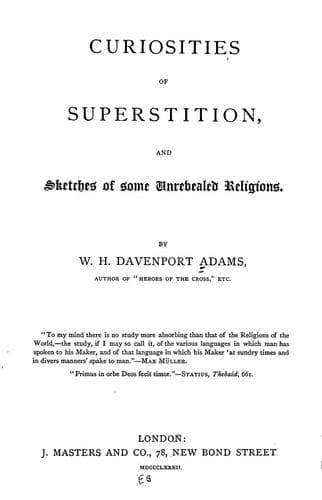
Curiosities of Superstition, and Sketches of Some Unrevealed ReligionsAdams, W. H. Davenport (William Henry Davenport)
Religion
Curiosities of Superstition, and Sketches of Some Unrevealed Religions
Adams, W. H. Davenport (William Henry Davenport)
Folklore; Religions; Superstition
The writer whom we have already quoted remarks that, whatever doubts may
arise on speculative points, the clearly defined outlines of the great
Serpent-mound of Oban are beyond dispute; though it may long prove a
fertile subject for discussion, whether its serpentine, or rather, Saurian
form is to be accepted as direct evidence of ophiolatry in this land, or
whether we should regard it as simply the representative of some
tribe,--as, in short, a Totem of some extinct British race answering to
the Nagas, or snake-tribes of the East. The former supposition seems the
more reasonable, when we remember that the serpent and the serpent’s egg
were held sacred by the Druids. Serpent-worship prevailed in every nation
of antiquity. It flourished in Greece and Rome, in Egypt and Chaldea, in
Arabia and Central Asia; it extended throughout the Indian peninsula from
Cape Comorin to Kashmir; it was practised in Ceylon and the islands of the
eastern seas; in Mexico and Peru; throughout the whole of Africa. Passing
northward, we find that it existed in Scythia and Scandinavia, as also
among vast tribes near the Oural mountains and throughout Northern Europe,
and particularly among the tribes on the Ob or Obi river, which owes its
name, it is said, to the veneration paid to the reptile. Until the end of
the fourteenth century, when Christianity was introduced, the people of
Poland worshipped domestic serpents, which were allowed to run free in
every house, and carefully tended, every mishap that occurred being
attributed to some negligence in their service. The Lapps, the Finns, the
Norwegians, the Swedes, the Danes, all fostered these strange household
gods, and shared with them the children’s milk. The Vandals also kept
them; some lived in hollow trees, and thither repaired the women, with
their offerings of milk, as is common at the present day in Ceylon and
many parts of India. Long after they had accepted the faith of CHRIST, the
Lombards continued a form of serpent-worship, adoring, or paying homage
to, a golden viper and a tree. In 663, Barbatus, Bishop of Benevento,
finding the custom still observed, made a successful appeal to the
worshippers to cut down the tree, and allow him to melt the golden viper
into a sacramental chalice.
One of the most interesting of the supposed Serpent-temples, or
_dracontia_, is that of Karnak. It is situated half a mile from the
village of that name, in the department of the Morbihan in Brittany, and
about nine miles from the picturesque town of Auray. It is also within a
mile of the Bay of Quiberon.
Public-domain text, read in full here on John Shaqi.
Reviews
Reviews
No reviews yet
Be the first to share your thoughts on this work.
Elsewhere in the archive
Join the Discussion
Join the discussion
Sign in to leave a comment or review.
Sign InorCreate an account