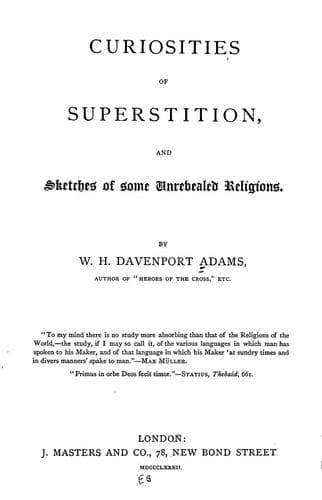
Curiosities of Superstition, and Sketches of Some Unrevealed ReligionsAdams, W. H. Davenport (William Henry Davenport)
Religion
Curiosities of Superstition, and Sketches of Some Unrevealed Religions
Adams, W. H. Davenport (William Henry Davenport)
Folklore; Religions; Superstition
The whole length of “the Stones of Karnak,” as the temple is called,
measures, if we include its sinuosities, eight miles. The width varies
from 250 to 350 feet. The highest stones are as much as seventeen feet
high, and from thirty to forty feet in circumference. Vacant spaces have
unfortunately been cleared by ruthless spoliators for the erection of the
adjacent villages of Ploermel and Karnak, and the boundary walls of the
neighbouring fields. But what toil and time must have been originally
expended on its construction, we may infer from the fact that it consisted
of eleven rows of stones, about ten thousand in number, of which upwards
of three hundred averaged from fifteen to seventeen feet in height, and
from sixteen to twenty or thirty feet in girth; one stone even measuring
the huge circumference of forty-two feet.
A glance at any engraving of this famous antiquity will show that the
course of the avenues is distinctly sinuous, and that it defines the
figure of an enormous serpent undulating over the ground. Necessarily,
however, the resemblance is more striking to one who views the original
_in situ_. To such, the alternations of the high and low stones, regularly
disposed, may seem to mark with sufficient accuracy “the swelling of the
serpent’s muscles as he moves along,” though this seems rather a flight of
imagination. But at all events the spectator will acknowledge the evidence
of design which clearly appears in the construction of the avenues.
The Dracontium contains ten regularly defined areas; one near the village
of Karnak, which is shaped like a bell or horse-shoe; the other, towards
the eastern extremity, which approaches the figure of a rude circle, and
is in reality a parallelogram with rounded corners.
The circle and the horse-shoe were both sacred figures in the Druidical
religion, as may be seen in Stonehenge, where they are united, the outer
circles enclosing inner horse-shoes. The connection between the latter
symbol and the Celtic faith is not very clear, unless it be intended as a
representation of the moon. It has been conjectured that from this symbol,
whatever may have been its signification, arose the superstition--even not
now wholly defunct--of nailing a horse-shoe over a door as a protection
against evil spirits.
Public-domain text, read in full here on John Shaqi.
Reviews
Reviews
No reviews yet
Be the first to share your thoughts on this work.
Elsewhere in the archive
Join the Discussion
Join the discussion
Sign in to leave a comment or review.
Sign InorCreate an account