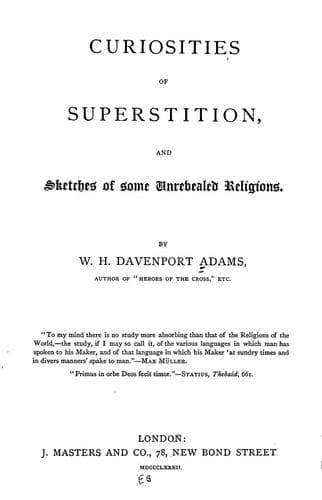
Curiosities of Superstition, and Sketches of Some Unrevealed ReligionsAdams, W. H. Davenport (William Henry Davenport)
Religion
Curiosities of Superstition, and Sketches of Some Unrevealed Religions
Adams, W. H. Davenport (William Henry Davenport)
Folklore; Religions; Superstition
It is on behalf of children that Snake-worship is particularly practised;
and the women and children of a family invariably accompany the male head,
not only at the annual festival, but whenever a vow has been made to a
Serpent Deity. The first hair shaved from a child which has passed
teething, and gone through the other infantile ailments, is frequently
dedicated to a Serpent. On such occasions the child is taken to the
locality of the vow, the usual ceremonies are performed, and with the
other offerings is included the child’s hair. In every case a feast
follows, served near the spot, and the attendant Brahmins receive alms and
largess.
“In the Shakti ceremonies, Pooma-elhishék, which belong, I think, to
aboriginal customs, the worship of the Snake forms a portion, as
emblematical of energy and wisdom. Most of these ceremonies are, however,
of an inconceivably obscene and licentious character. They are not
confined to the lowest classes, though rarely perhaps resorted to by
Brahmins; but many of the middle class sects, of obscure origin and
denomination, practise them in secret, under the strange delusion that the
divine energy of nature is to be obtained thereby, with exemption from
earthly troubles.
“Although Snake-worship ordinarily belongs professedly to the descendants
of aboriginal tribes, yet Brahmins never or rarely pass them over, and the
Nagpanchani is observed as a festival of kindly greeting and visiting
between families and friends--as a day of gifts of new clothes or
ornaments to wives or children, &c.
“The worship of Gram Deotas, or village divinities, is universal all over
the Dekhan, and indeed I believe throughout India. These divinities have
no temples nor priests. Sacrifice and oblation is made to them at sowing
time and harvest, for rain or fine weather, in time of cholera, malignant
fever, or other disease or pestilence. The Nag is always one of the Gram
Deota, the rest being known by local names. The Gram Deota are known as
heaps of stones, generally in a grove or quiet spot near every village,
and are smeared some with black and others with red colour.
“Nâg is a common name both for males and females among all classes of
Hindus, from Brahmins downwards to the lowest classes of Sudras and
Mléchhas. Nâgo Rao, Nâgoju, &c., are common Mahratta names, as Nagappa,
Nagowa, and the like are among the Canarese and Telugu population.
“No Hindu will kill a Nag or Cobra willingly. Should any one be killed
within the precincts of a village, by Mahomedans or others, a piece of
copper money is put into its mouth, and the body is burned with offerings
to avert the evil.
“It is, perhaps, remarkable, that the Snake festival is held after the
season or at the season of casting the skin, and when the Snake, addressed
or worshipped, is supposed to have been purified. Some Brahmins always
keep the skin of a Nag in one of their sacred books.
Public-domain text, read in full here on John Shaqi.
Reviews
Reviews
No reviews yet
Be the first to share your thoughts on this work.
Elsewhere in the archive
Join the Discussion
Join the discussion
Sign in to leave a comment or review.
Sign InorCreate an account