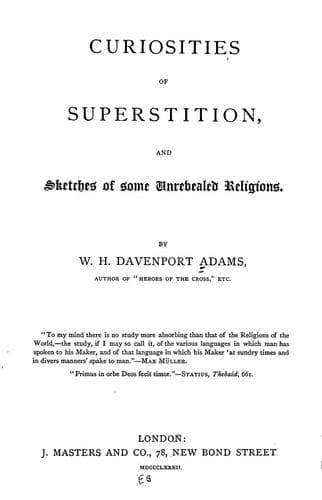
Curiosities of Superstition, and Sketches of Some Unrevealed ReligionsAdams, W. H. Davenport (William Henry Davenport)
Religion
Curiosities of Superstition, and Sketches of Some Unrevealed Religions
Adams, W. H. Davenport (William Henry Davenport)
Folklore; Religions; Superstition
“On one occasion,” says Mr. Williams, “a vessel from New South Wales
touched at the Samoas, the captain of which had on board a cockatoo that
talked. A chief was invited to the ship, and shortly after he entered the
cabin the captain began a colloquy with the bird. At this he was struck
with amazement, trembled exceedingly, and immediately sprang upon deck,
leaped into the sea, and called aloud to the people to follow him,
affirming the captain had his _devolo_ on board, which he had both seen
and heard. Every native dashed at once into the sea, and swam to shore
with haste and consternation; and it was with much difficulty that they
could be induced to revisit the ship, as they believed that the bird was
the captain’s _etu_, and that the spirit of the devil was in it.”
Another illustration is given by Mr. Williams:--
“While walking,” he says, “on one occasion, across a small uninhabited
island, in the vicinity of Tongatabu, I happened to tread upon a nest of
sea snakes. At first I was startled at the circumstance, but being assured
that they were perfectly harmless, I desired a native to kill the largest
of them as a specimen. We then sailed to another island, where a number of
heathen fishermen were preparing their nets. Taking my seat upon a stone
under a tou tree, I desired my people to bring the reptile, and dry it on
the rocks; but as soon as the fishermen saw it, they raised a most
terrific yell, and, seizing their clubs, rushed upon the Christian
natives, shouting: ‘You have killed our god, you have killed our god!’ I
stepped in between them, and with some difficulty stayed their violence,
on the condition that the reptile should be immediately carried back to
the boat.”
The Polynesian islanders, or most of them, seem to have cherished a
general idea of a Supreme Being, whom they regarded as the Creator of all
things and the Author of their mercies. They called him Tangatoa; and at
their great feasts, before the food was distributed, an orator would
rise, and after enumerating each viand on the board, would say: “Thank you
for this, great Tangatoa!”
The worship or _cultus_ observed by the islanders included prayers,
offerings of pigs, fish, vegetables, canoes, native cloth, and the like,
and incantations. To these must be added the dread rite of human
sacrifice. Of the style of their addresses to the gods one may form an
idea from the formula with which they were accustomed to conclude it.
Having presented the gift, the priest would say: “Now, if you are a god of
mercy, come this way, and be propitious to our offering; but if you are a
god of anger, go outside the world,--you shall have neither temples,
offerings, nor worshippers here.”
Public-domain text, read in full here on John Shaqi.
Reviews
Reviews
No reviews yet
Be the first to share your thoughts on this work.
Elsewhere in the archive
Join the Discussion
Join the discussion
Sign in to leave a comment or review.
Sign InorCreate an account