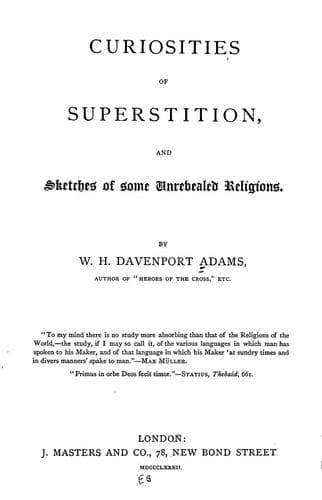
Curiosities of Superstition, and Sketches of Some Unrevealed ReligionsAdams, W. H. Davenport (William Henry Davenport)
Religion
Curiosities of Superstition, and Sketches of Some Unrevealed Religions
Adams, W. H. Davenport (William Henry Davenport)
Folklore; Religions; Superstition
As in other savage countries, they sought to propitiate the gods by
inflicting physical injuries upon themselves. The Sandwich Islanders, in
performing some of their rites, would knock out their front teeth; the
Friendly Islanders would cut off one or two of the bones of their little
fingers. So common was the latter practice, that few were to be found who
had not in this way mutilated their hands. One missionary relates that, on
one occasion, a chief’s daughter,--a fine young woman about eighteen years
of age,--was standing by his side, when he observed by the condition of
the wound that she had recently performed the ceremony. Taking her hand,
he asked why she had cut off her finger? There was a touch of pathos in
her reply. Her mother was ill, and fearing lest she should die, she had
mutilated herself in the hope the gods would preserve her life. “Well, and
how did you do it?” “I took a sharp shell, and worked it about until the
joint was separated, and then I allowed the blood to stream from it. This
was my offering to persuade the gods to restore my mother.” One cannot
doubt the genuineness of the filial affection which could make such a
sacrifice, though we may wish that it had been more wisely exercised.
When a second offering was required, the votary severed the second joint
of the same finger. If a third or fourth were demanded, he amputated the
same bones of the other little finger; and when he had no more joints that
he could conveniently spare, he would rub the stumps of his mutilated
fingers with rough stones, until the blood again streamed from the wounds.
Human sacrifices, as we have said, were very numerous, especially in the
Henry, the Tahitian, and the Society island groups. At the so-called Feast
of Restoration (_Raumatavchi raa_,) no fewer than seven victims were
required. It was always celebrated after an invading army had forced the
inhabitants to retreat to the mountains, and had desecrated the maraes by
cutting down the branches of the sacred trees, and cooking their food with
them, and with the wooden altars and decorations of the sacred place.
Public-domain text, read in full here on John Shaqi.
Reviews
Reviews
No reviews yet
Be the first to share your thoughts on this work.
Elsewhere in the archive
Join the Discussion
Join the discussion
Sign in to leave a comment or review.
Sign InorCreate an account