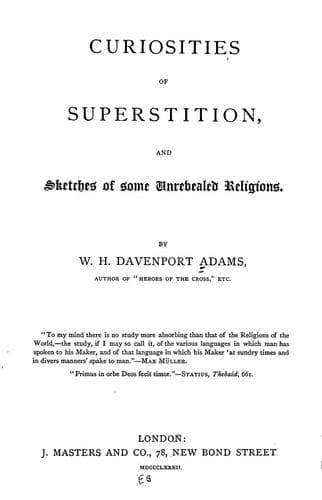
Curiosities of Superstition, and Sketches of Some Unrevealed ReligionsAdams, W. H. Davenport (William Henry Davenport)
Religion
Curiosities of Superstition, and Sketches of Some Unrevealed Religions
Adams, W. H. Davenport (William Henry Davenport)
Folklore; Religions; Superstition
At the inauguration of their greatest kings, the islanders used what was
called _Maro ura_, or the red sash. This was a piece of network, about six
feet long and seven inches wide, upon which the red feathers of the
parroquet were neatly fastened. A chief could receive no more honourable
appellation than that of _Arii maro ura_, “King of the Red Sash.” A new
piece, about eighteen inches long, was attached at every sovereign’s
inauguration; and on all such occasions several human victims were
required. A sacrifice was made, first for the _mau raa tite_, or the
extension of the network upon pegs, in order to attach to it the new
piece. A second was necessary for the _fatu raa_, or actual attachment;
and a third for the _piu raa_, or twitching the sacred relic off the pegs.
These ceremonies not only invested the sash itself with peculiar
solemnity, but also rendered the chiefs who wore it more important in the
eyes of the people. Well might it be so, when the thing was dyed, as it
were, in innocent human blood.
Human sacrifices were also offered on the breaking out of war. Mr.
Williams remarks that a correct idea of the extent to which this system is
carried may be obtained from a relation of the circumstances under which
the last Tahitian victim fell, immediately prior to the introduction of
Christianity. Pomare, king of Tahiti, was on the point of fighting a
battle which would assure his supremacy or deprive him of his dominions.
It became to him, therefore, a matter of the highest concern to propitiate
the gods by the most valuable offerings he could command. For this
purpose, rolls of native cloth, pigs, fish, and immense quantities of
other food were presented at the maraes; but the gods (or their priests)
would not be satisfied; a human victim was demanded. Pomare, therefore,
sent two of his messengers to the house of the victim, whom he had marked
for the occasion. On reaching the place they inquired of the wife where
her husband was, and she, in her innocence, gave the required explanation.
“Well,” they continued, “we are thirsty; give us some cocoa-nut water.”
She had no nuts in the house, she replied, but they were at liberty to
climb the trees, and take as many as they desired. They then requested her
to lend them the _O_,--a piece of ironwood, about four feet long and an
inch and a half in diameter, with which the natives open the cocoa-nut.
She cheerfully consented, little suspecting that she was placing in their
murderous hands the instrument which, in a few moments, was to inflict a
fatal blow on her husband’s head. Upon receiving the _O_, the men left the
house, and went in search of their victim; and the woman, her suspicions
being excited, followed them shortly afterwards, reaching the scene just
in time to see the blow inflicted, and her husband fall.
Public-domain text, read in full here on John Shaqi.
Reviews
Reviews
No reviews yet
Be the first to share your thoughts on this work.
Elsewhere in the archive
Join the Discussion
Join the discussion
Sign in to leave a comment or review.
Sign InorCreate an account