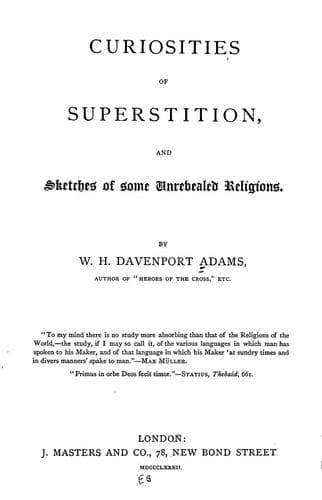
Curiosities of Superstition, and Sketches of Some Unrevealed ReligionsAdams, W. H. Davenport (William Henry Davenport)
Religion
Curiosities of Superstition, and Sketches of Some Unrevealed Religions
Adams, W. H. Davenport (William Henry Davenport)
Folklore; Religions; Superstition
Then as to his modesty, it was as supreme as that of a virgin who has
never seen men. One day Prasenagit, his royal disciple and protector,
besought him to work some miracles in order to silence his adversaries,
the Brahmans. Buddha complied, and performed the required miracles; but at
the same time he exclaimed, “Great King, I do not teach the law to my
pupils, telling them, Go, ye saints, and before the eyes of the Brahmans
and householders perform, by means of your supernatural powers, miracles
greater than any man can perform. I tell them, when I teach the law, Live,
ye saints, hiding your good works and showing your sins.” And yet, all
this self-sacrificing charity, all this self-sacrificing humility by which
the life of Buddha was distinguished throughout, and which he preached to
the multitudes that came to listen to him, had but one object, and that
object was final annihilation.[11]
Annihilation! what drearier prospect can be opened to the heart, or soul,
or mind of man? The utter cessation of that individuality of which the
meanest and wretchedest among us feels proudly conscious; of the thoughts
which animate, the desires which warm, the dreams that delight, the hopes
that stimulate, the affections that inspire! Do we indeed suffer all the
sorrows and uncertainties of life,--do we indeed strive, and endure, and
struggle,--do we, indeed, learn to labour and to wait, to bear the burden
of the day and the torture of the night, for no other purpose, with no
other prospect, than when the brief fever is over, to pass away into
nothingness? With so much difficulty can the mind reconcile itself to such
a dreary hypothesis that the creed of almost every race and people has
contemplated a future stage of existence, even when it has failed to
attain to anything like a clear and full conviction of the immortality of
the soul. The law of compensation seems to demand that a future life shall
redress the inequalities of the present.
Yet this doctrine of Annihilation was preached by Buddha, and apparently
accepted by the millions who became his disciples. But did they really
accept it as he preached it? No; the truth is, they read into it, as it
were, their own innate, unconquerable belief in a hereafter, and converted
his Nirvâna into a Paradise, which they embellished with the bright
colours of imagination. It can hardly be doubted that this was not the
meaning or intention of Buddha himself. Look, for a moment, at his “Four
Verities.” The first of these, as we have already stated, asserts the
existence of pain; the second, that the cause of pain is sin; the third,
that the cessation of pain may be secured by Nirvâna; the fourth, that the
way to this Nirvâna consists of eight things: right faith or orthodoxy,
right judgment or logic, right language or veracity, right purpose or
honesty, right practice or religious life, right obedience or lawful life,
right memory, and right meditation.
Public-domain text, read in full here on John Shaqi.
Reviews
Reviews
No reviews yet
Be the first to share your thoughts on this work.
Join the Discussion
Join the discussion
Sign in to leave a comment or review.
Sign InorCreate an account